
What Cross Country Trains Taught Me About Process Management (Without Meaning To)

I travelled to Edinburgh last week for the Engage Process Scotland Customer Day. It turned out to be a journey about process management in more ways than one.
I should say upfront that I am professionally incapable of experiencing a service without mentally mapping how it works. It is an occupational habit — possibly a condition. I notice queues, handovers, decision points, waste, and failure demand in the same way other people notice the weather. On this particular journey, I had ample material to work with.
Normally I fly from Bristol — EasyJet, extra legroom seats at the front, because at 6’7″ the alternative isn’t really an option. But this time the only available flight with those seats was at 6am. That means leaving Torquay at 1:30 in the morning. It means a night of broken sleep because your brain won’t let you fully rest when you know you have to be up at that hour. The door-to-door time for flying, when you account for the drive to Bristol, parking, security, and everything else, is not as quick as it sounds. So I looked at the train.
Newton Abbot to Edinburgh. About eight hours. The east coast line up into Scotland is supposed to be beautiful. I’d always wanted to try it. And I could work on the way up — laptop open, a long uninterrupted stretch of time to get things done.
That was the theory.
The train arrived with five coaches. One of them first class. This is a Penzance-to-Aberdeen service. Anyone who has looked at a map will understand the problem immediately. Cross Country Trains, however, appeared not to have considered it.
My reserved seat at a table was already occupied by three people and a baby. I found a spare seat, sat down, and waited to see how bad it would get.
Before we’d even reached Teignmouth, we stopped. A train ahead had its brakes stuck on. After fifteen minutes or so we got moving again, joining a queue of delayed trains inching through every station towards Bristol. By the time we reached Bristol, first class was standing room only. People who hadn’t booked were coming in, frustrated, looking for somewhere to sit, arguing with staff who couldn’t do much about it.
Just past Bristol, the train manager announced that they were withdrawing the first class service. Too busy, not enough staff. We were advised to call customer services for a partial refund.
Past Birmingham the train was so overcrowded that staff stopped checking tickets for several stops — precisely the moment when unchecked access to first class was at its highest. Then, to claw back some of the forty-five-minute delay, they bypassed three stops around Leeds. People who had been on the train for four or five hours, heading to those stations, had to get off and find alternative connections. Nobody had warned them.
Every crew change — and there were several — brought staff who said the same thing: they weren’t supposed to be working this train.
Then there were the announcements. On both legs of the journey, most of them were too quiet or too distorted to follow. The important ones — route changes, delays, service disruptions — came through as a muffled blur. There was, however, one consistent exception. The announcement for the buffet car came through on every occasion loud, clear, and perfectly intelligible.
I will leave you to draw your own conclusions about what that says about organisational priorities. I will only add that when a train is running forty-five minutes late and bypassing stops without warning, clear communication is not a nice-to-have. It is a safety matter.
I got into Edinburgh forty-five minutes late.
The return journey on Wednesday was mostly fine, other than the train manager deploying their one available staff member to push a trolley through standard class rather than serve first class — despite a shop at the other end of the train that standard class passengers could use. The logic was unclear. The feeling, as a first class passenger who had paid a premium for the service, was familiar.
Here’s the thing. Cross Country Trains know exactly how busy that route is. They have the booking data. They know the train runs the length of Britain. There is no reasonable world in which five coaches is the right answer for that service on that day. This wasn’t bad luck. It was a predictable outcome of decisions made — or not made — well in advance.
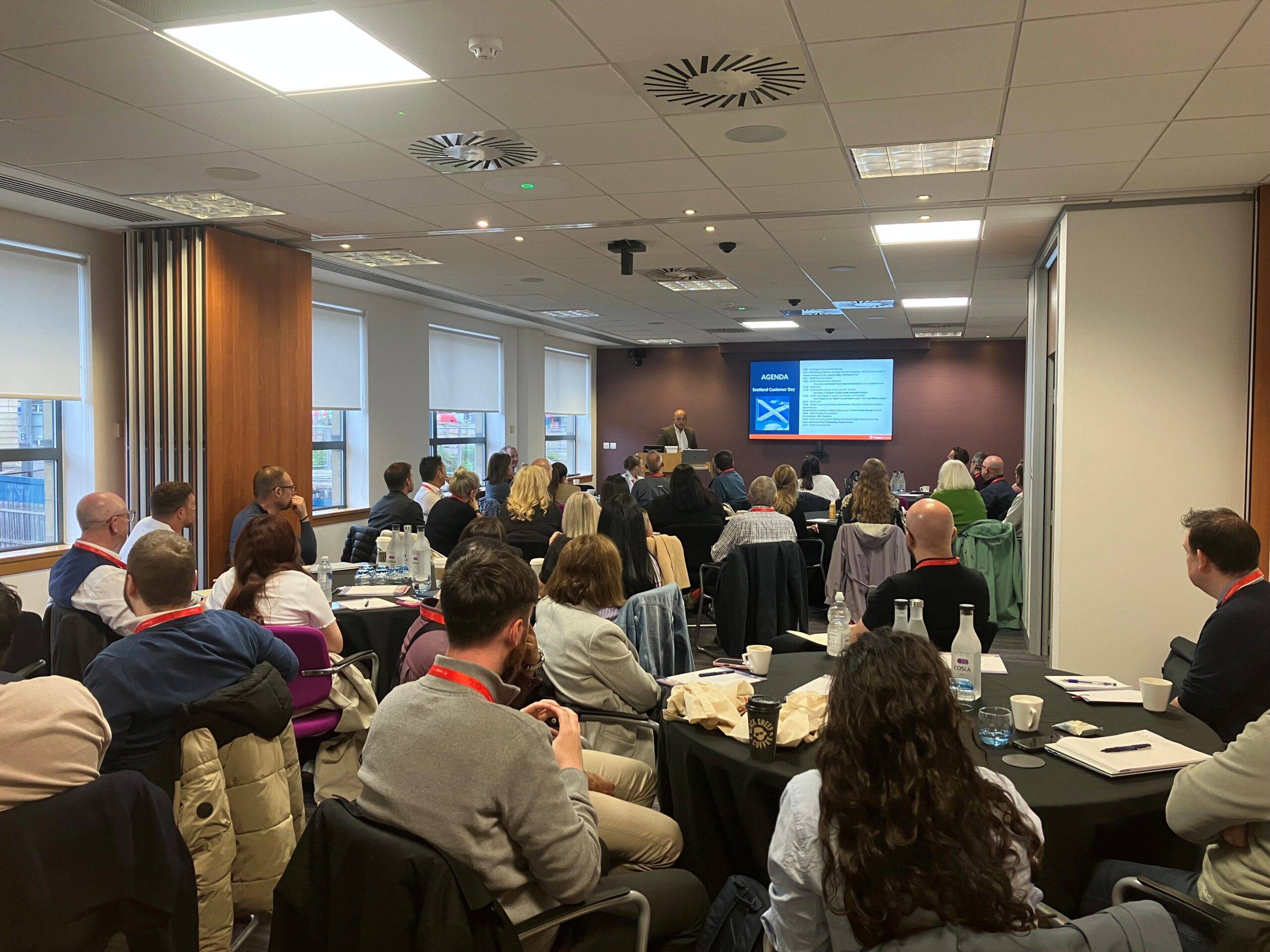
Ted Twaalfhoven, founder of Engage Process, opened the Scotland Customer Day with a question that stuck with me: “How do you keep control over all of these?” He was talking about the wave of simultaneous pressures facing organisations right now — AI, new legislation, cost savings, system changes, restructuring, all landing at once. His point was that process improvement alone is not enough. You need process management: a structured, organisation-wide approach to understanding how work actually happens, so that when change comes you’re acting on knowledge rather than instinct.
Forrester put it this way in research cited at the event: AI technologies are not stable. They change all the time. Reliable for three to six months, at most. Which means if you build your operations around AI tools without first understanding and governing the underlying processes, you are building on sand.
Chris Wright from Perth and Kinross Council presented what it looks like to get this right. His team have made Engage Process mandatory before any AI deployment can proceed. Map the as-is process, model the to-be, capture the baseline — then and only then deploy into a known process and validate with real results. No process map, no AI project. That is the rule.
The numbers that followed were striking: 87 minutes saved per welfare rights meeting, across up to 1,800 meetings a year. 600 Microsoft Copilot licences, with 73% used daily and zero cancellation requests. All of it audit-defensible because all of it was measured against a documented baseline.
PKC was not the only story worth telling from the day.
Fiona Gray from the Improvement Service — the national body for local government improvement in Scotland — showed what process management looks like at national scale. The Blue Badge reform project mapped a single standardised process across all 32 Scottish councils, each of which had been running the service differently. The Visitor Levy project — Scotland’s first — went further still: an entirely new service, designed from scratch, with Engage Process used to model the complexity of multiple authentication routes, registration methods, payment channels, and enforcement scenarios. That platform went live in April 2026. Engage Process was the structure that made it possible to design across that complexity without losing track of it.
Ann Short from South Lanarkshire Council presented the internal reality of a corporate rollout: 146 trained modellers, 76 approvers, 17 process champions, 5 administrators. South Lanarkshire moved from a situation where different teams were using incompatible tools with no common language, to a single platform accessible to everyone. The efficiency savings identified run into the millions. But the observation that stayed with me was a cultural one: staff are often reluctant to report time savings in case it triggers budget cuts. This is a real problem, and it is one that good process governance has to address directly. You cannot build a culture of continuous improvement if the people best placed to spot waste are afraid to say so.
After lunch came the session I had been looking forward to most — and not only because of what was in it.
Nicola Ratcliffe, Customer and Digital Delivery Lead at Torfaen County Borough Council, presented on transforming revenue services using a structured methodology called DARE to Transform: Define, Analyse, Re-engineer, Evaluate. The work covered Council Tax, Business Rates, and Benefits across a shared service for Torfaen and Monmouthshire. Over fifty improvement opportunities were identified, scored, and turned into concrete proposals. The most recent piece — digitising the process for visiting officers checking new build properties — showed what it looks like to take a manual, paper-based workflow and turn it into something that works in the field, on a phone, in places with poor signal.
What makes Nicola’s session personally significant is something the audience would not have known. Nicola is a former colleague. We worked together at Goss Interactive years ago. When I was first getting to grips with Engage Process and what it could do, it was Nicola who made the connection and helped me see the potential clearly. Watching her present at an Engage Process conference, having built a whole service transformation methodology around the platform, is not something I had expected — and it is one of those moments you do not quite plan for.
Cross Country Trains almost certainly have more data about their operations than most councils have about theirs. Booking volumes, delay patterns, staffing requirements, route loading — it is all there. What they appear to lack is any process management infrastructure to act on it. The data exists. The decisions get made as though it doesn’t.
I arrived in Edinburgh forty-five minutes late and went straight into a day of presentations about why that happens, and what to do about it.
One thing I will say about the Cross Country staff: they were, without exception, good people doing their best in an impossible situation. Apologetic, helpful, trying to manage passengers who were understandably frustrated. None of what went wrong on either journey was their fault. It was the result of decisions made — or not made — long before any of them got on the train.
This is something I come back to constantly in process improvement work. Bad processes, not bad people. The people will nearly always do their best within the constraints they are given. If those constraints are poorly designed, under-resourced, or simply not thought through, the people carry the consequences — and so do the customers. The solution is never to blame the individuals. It is to fix the process.
The staff on that train deserved better. So did the passengers.
I won’t be taking the train again. But I am glad I went.
We Are Lean and Agile are UK partners for Engage Process, specialising in local government. If you’d like to talk about how process management could work in your organisation, get in touch at [email protected]