
Gloucestershire Stayed Whole. Devon Got Carved Into Four. Here's Why That Matters.
Two counties, one written ministerial statement, two completely different ideas of what local government reorganisation is for.
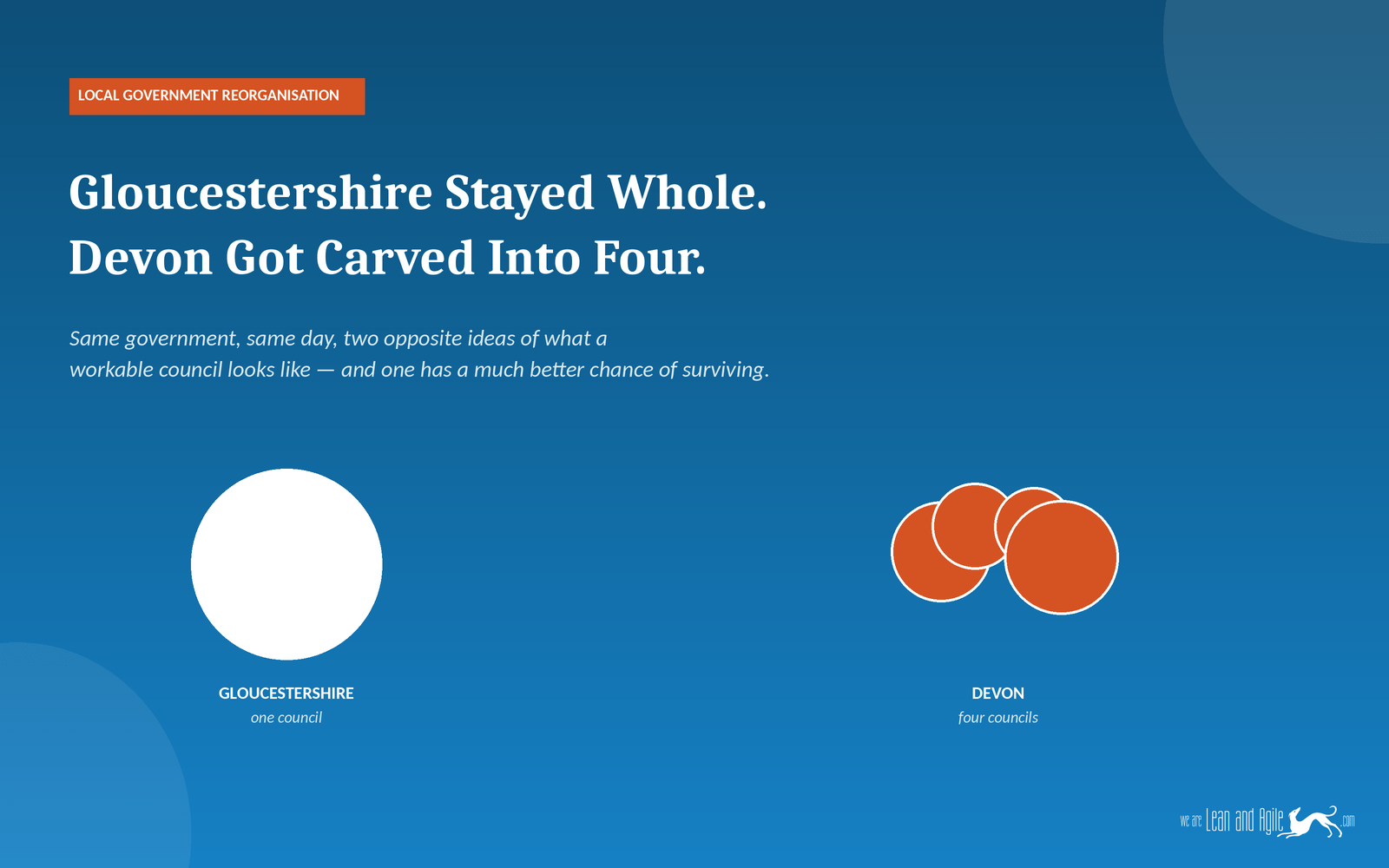
On 16 July 2026, the same statement to Parliament confirmed the future of both Gloucestershire and Devon. Both are large, mixed urban-and-rural counties. Both went through the same statutory process, against the same criteria, judged by the same Secretary of State.
Gloucestershire came out as one council. Devon came out as four.
That’s not a small difference in administrative tidiness. It’s two opposite theories of what makes a council viable — and only one of them has broad local consent behind it. Worth looking at closely, not least because I live in Devon and have watched this one up close.
Gloucestershire: kept whole
Gloucestershire’s seven councils — the county council plus Cheltenham, Cotswold, Forest of Dean, Gloucester, Stroud and Tewkesbury — will become a single unitary authority covering 669,380 people. The “One Gloucestershire” option was backed by the county council, Cotswold, Tewkesbury and Stroud. Cheltenham had pushed a different East-West split, and Gloucester City had submitted its own “Greater Gloucester” option. Forest of Dean opposed reorganisation altogether. But when the decision landed, three of the six district councils and the county were already aligned behind the option government chose.
The business case backing it claimed around £21 million a year in savings, £164 million over ten years. It comfortably clears the government’s original “around 500,000” ambition for new unitaries. And because it keeps the whole county together, the tax base stays intact — Cheltenham and Gloucester’s town centres sit inside the same authority as the rural Cotswolds and Forest of Dean, so the higher-value areas continue to help fund services across the county, the same way they always have.
No judicial review has been reported. Nobody’s happy about losing their district council, but nobody’s accusing the government of rigging the outcome either.
Devon: carved into four
Devon is a different story entirely.
Three plans competed for the same territory. Devon County Council proposed “One Devon” — a single unitary keeping the same boundaries as the existing county, with Plymouth and Torbay staying as they are. The district councils (bar Exeter) proposed a “4-5-1” split. And Plymouth, Exeter and Torbay put forward their own joint plan: expand each of their three existing urban footprints, and leave everything else as a fourth authority.
Government picked the cities’ plan.
Plymouth expands to roughly 300,000 people, absorbing part of South Hams. Exeter — currently a district council of around 130,000 — more than doubles to roughly 260,000, taking in Exmouth, Dawlish, Crediton and the surrounding area. Torbay expands from about 140,000 to roughly 230,000, adding 22 parishes carved out of South Hams and Teignbridge. Everything left over — East Devon, Mid Devon, North Devon, Torridge, West Devon, and whatever remains of South Hams and Teignbridge once the cities have taken their share — becomes a new authority called Devon Coast and Countryside, covering something in the region of 420,000–450,000 people (an estimate; the government hasn’t published an exact figure) across roughly 2,500 square miles, stretching about 110 miles from Salcombe in the south to Lynton in the north.
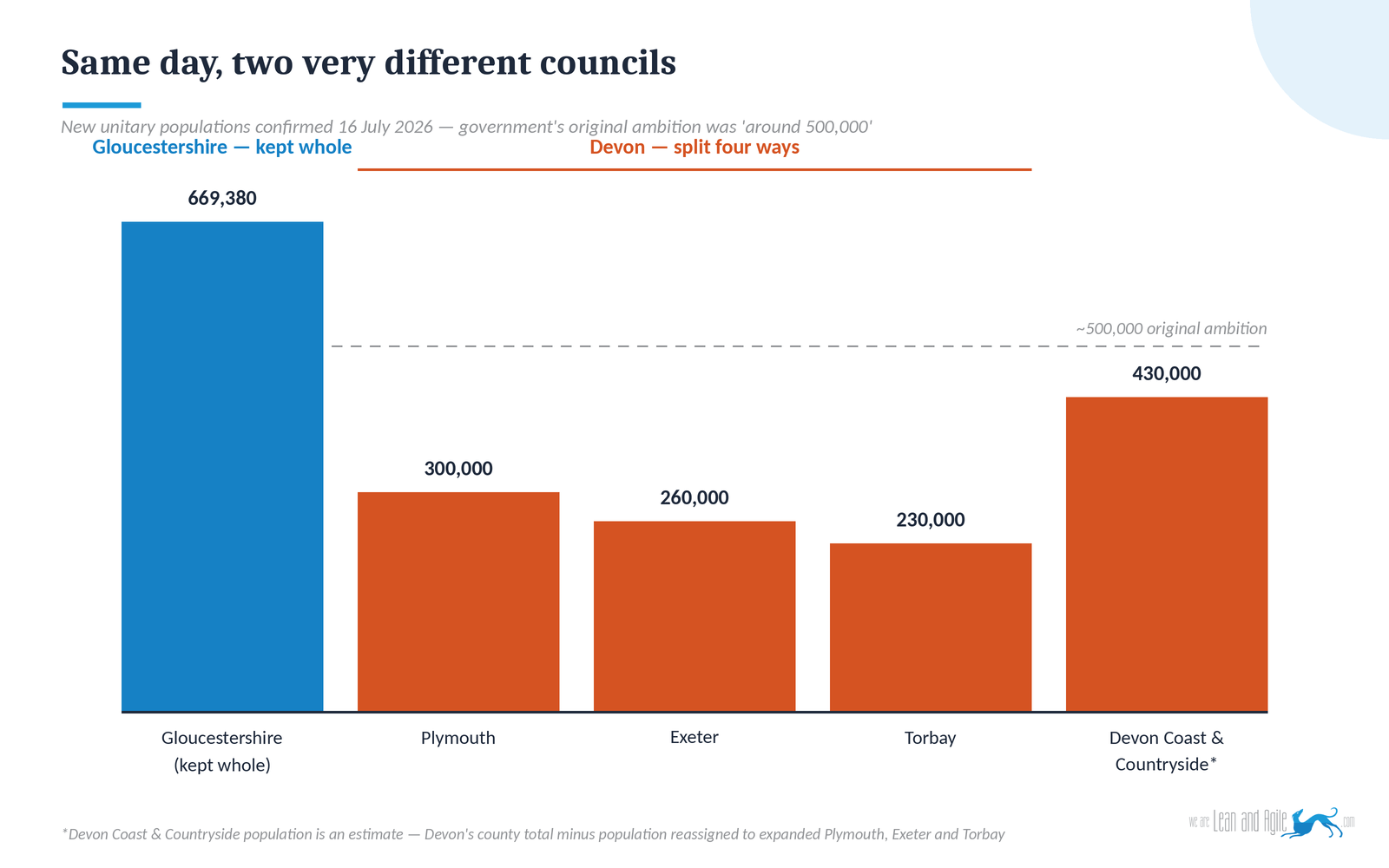
New unitary populations confirmed 16 July 2026. Government’s original ambition was “around 500,000” per unitary. Devon Coast & Countryside figure is an estimate — see note below the image.
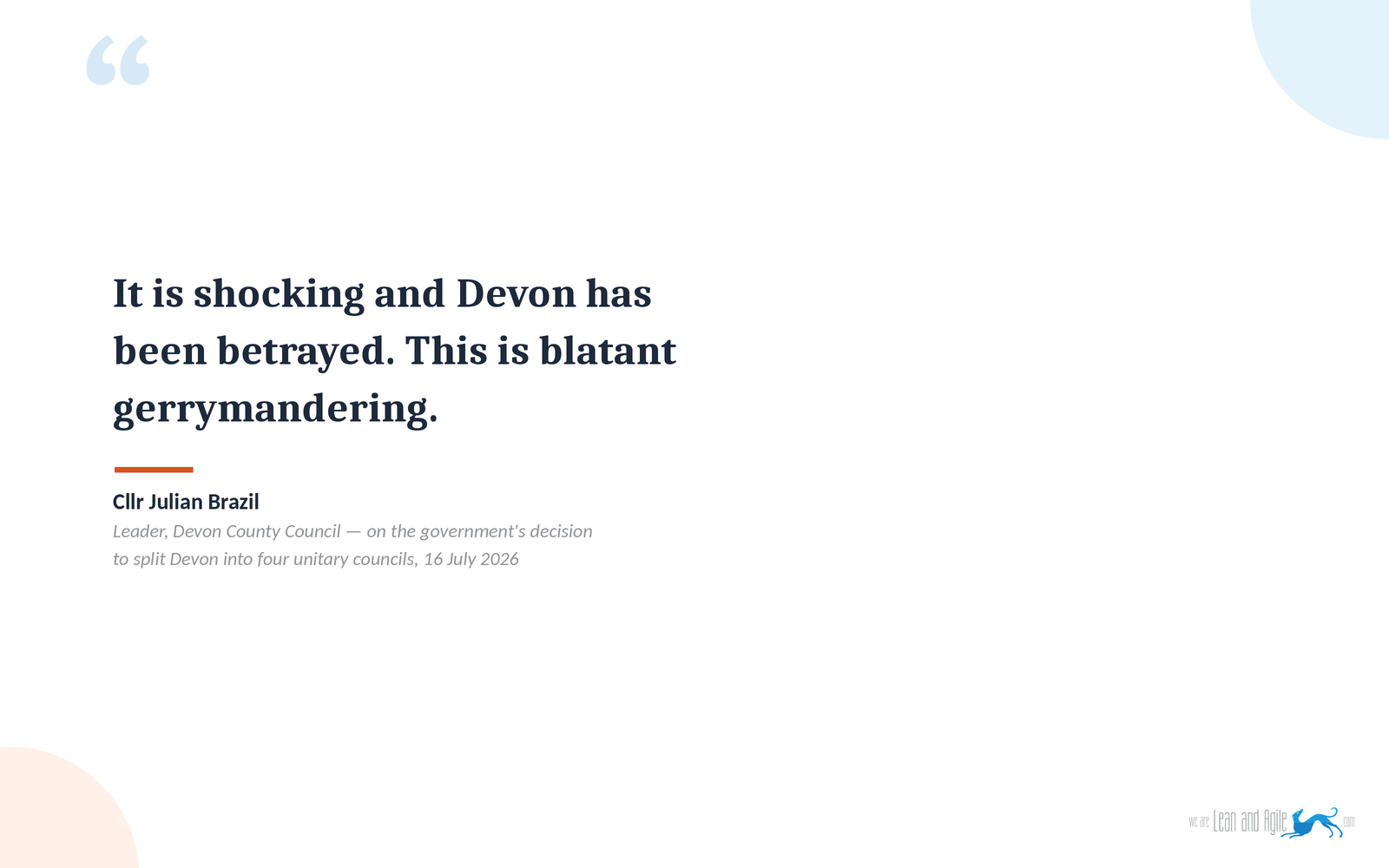
The reaction has been sharp. Devon County Council’s Liberal Democrat leader, Julian Brazil, called the decision “shocking,” said the county had been “betrayed,” and accused the government of “blatant gerrymandering” — pointedly noting that the winning proposal came from Exeter and Plymouth, both Labour-controlled, with Torbay’s Conservative administration has decided to cooperate rather than fight the outcome. Devon CC has since sent a formal letter of intent to launch a judicial review.
CPRE Devon, the countryside charity, has been just as blunt, calling the outcome a “bonanza” for the three expanded cities and a “disaster” for everyone else. Their argument is the same one that, in reverse, explains why Gloucestershire stayed together: a large rural area needs its urban centres’ tax base to help pay for the roads, education and social care that get more expensive per head the more thinly a population is spread. Devon Coast and Countryside loses Exeter, Plymouth and Torbay’s commercial rates and higher-value council tax bands, but keeps almost all of the rural cost base that made those services expensive to deliver in the first place.
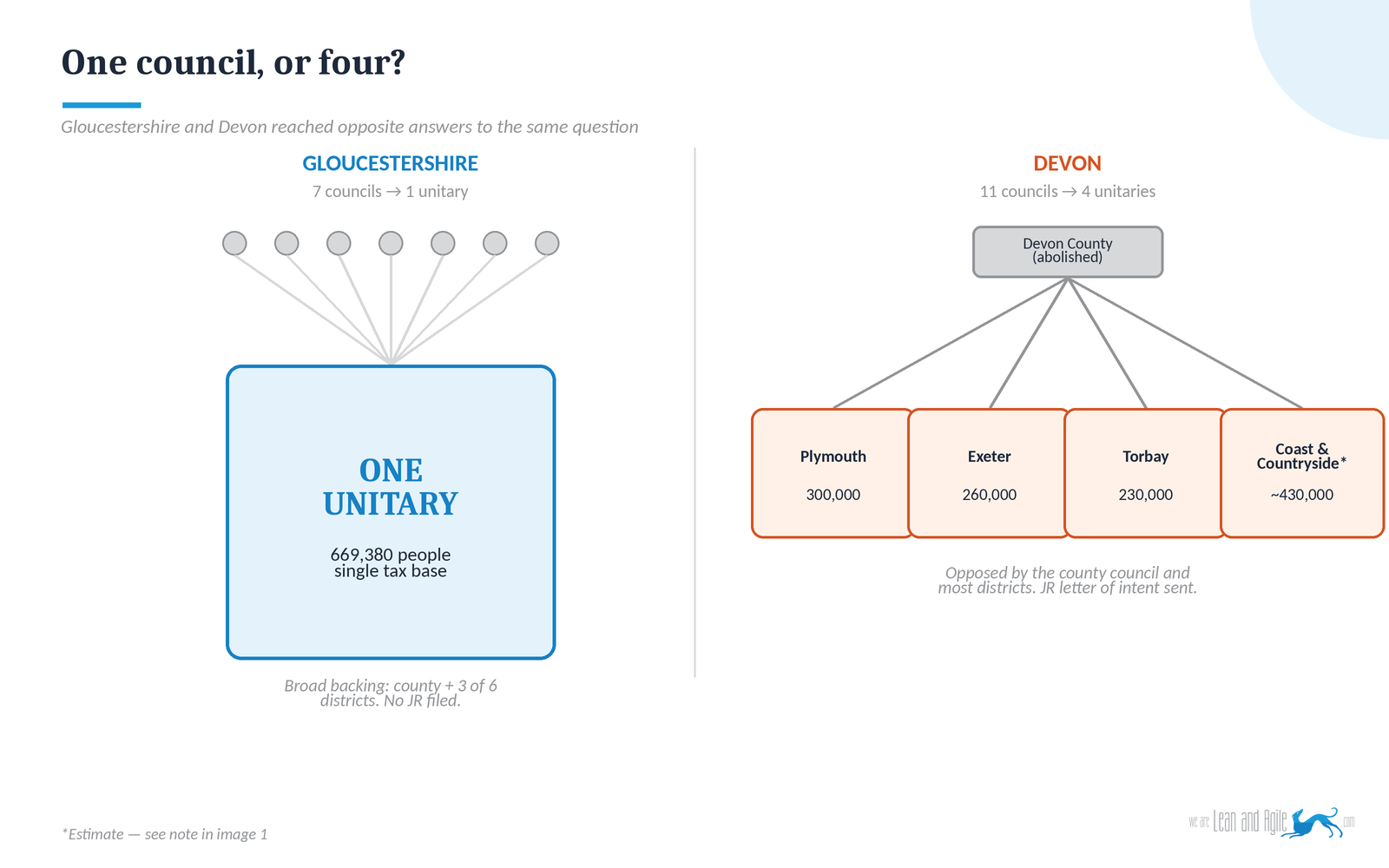
So which one has the better chance of working?
Line them up side by side and the gap is stark.
**Political consensus.** Gloucestershire’s winning option had the backing of the county council and three of six districts before the decision was even made. Devon’s winning option was opposed by the county council and every district except the three cities that proposed it.
**Legal risk.** No judicial review reported for Gloucestershire. Devon County Council has already sent a letter of intent — the formal first step towards judicial review proceedings — calling the geography “ridiculous” and the process “gerrymandering.” That’s a serious credibility problem for a structure that’s meant to be running services within twenty months.
**Financial viability.** Gloucestershire keeps its tax base and cost base together in one authority — an urban centre and a large rural hinterland, integrated, the way it’s always been. Devon separates them: three prosperous urban authorities gain population and commercial rates, while Devon Coast and Countryside inherits a rural cost base of roads, care and education spread across 2,500 square miles, without the town centres that used to help pay for it. CPRE’s warning isn’t political noise — it’s the same logic the government itself used to justify keeping other counties whole.
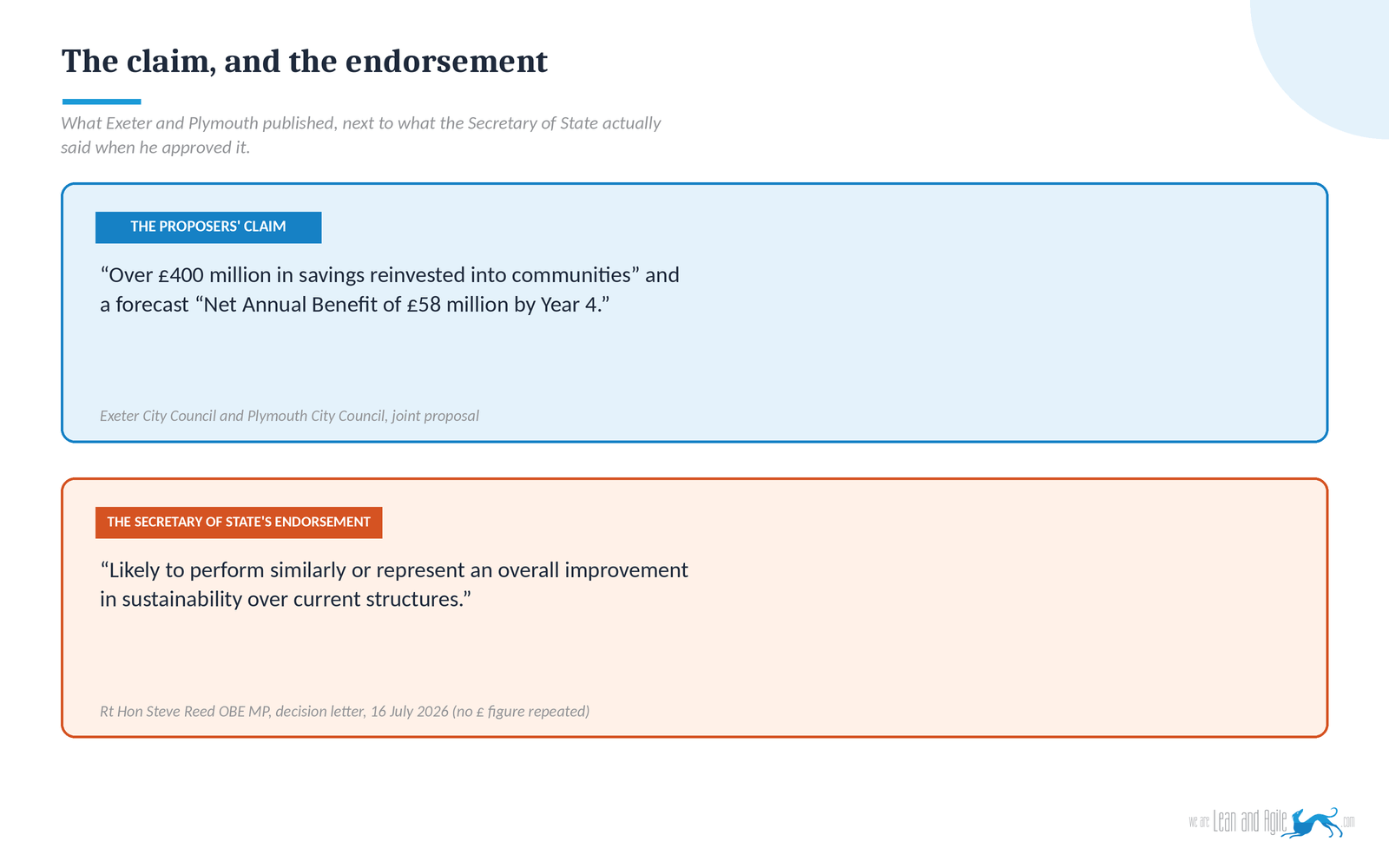
Here’s the detail worth sitting with. Exeter and Plymouth’s own proposal claims “over £400 million in savings” and a forecast “Net Annual Benefit of £58 million by Year 4.” That’s a specific, published, confident number. But when Steve Reed’s official decision letter explains why he approved it, he doesn’t repeat or endorse that figure anywhere. His actual assessment: the option is “likely to perform similarly or represent an overall improvement in sustainability over current structures.” That’s a considerably weaker claim than £400 million — and the letter states plainly that he “considered the expected costs and benefits set out in the options,” meaning the £400m figure was taken from the councils’ own submission, not independently verified. Exeter and Plymouth have now put a very large number into the public domain that the government approving it won’t actually stand behind.
**Population threshold.** Gloucestershire’s 669,380 clears the government’s original “around 500,000” ambition with room to spare. Of Devon’s four, only the Coast and Countryside authority gets close, and even that’s an estimate built on population reassigned away from it — every one of the three city authorities sits meaningfully below the figure ministers themselves set as the bar for viability. Steve Reed’s own decision letter confirms this directly: he acknowledges “all the new councils would be below the 500,000 population figure” and states that the figure “has always remained a guiding principle, not a fixed threshold.” Worth being clear about what that sentence actually does — it’s the Secretary of State, in the document explaining his own decision, saying the headline criterion his department published doesn’t bind him.
**Geographic coherence.** Gloucestershire’s new unitary matches a boundary residents already recognise — the county. Devon’s rural authority is a genuinely new entity stitched together from parts of five or six former districts, with no single dominant council whose systems, processes or identity it can simply extend. That’s not just a political headache. It’s an operational one: whoever runs Devon Coast and Countryside from 2028 will be harmonising services, systems and ways of working across a wider and more fragmented patchwork than almost any other unitary being created this year — with a smaller, thinner budget to do it on than the geography would suggest.
This isn’t just a local complaint, either. techUK’s own guidance to councils navigating reorganisation makes a similar point: there’s a “sweet spot” for the size of a new unitary, but size on its own doesn’t guarantee success, and models that fragment responsibility across multiple bodies are a recognised failure pattern — right alongside the opposite risk, of a single authority getting so large it feels remote from the communities it serves. Devon Coast and Countryside is the fragmentation risk in a fairly pure form. Gloucestershire, for what it’s worth, is large enough that it will need to watch for the other one.
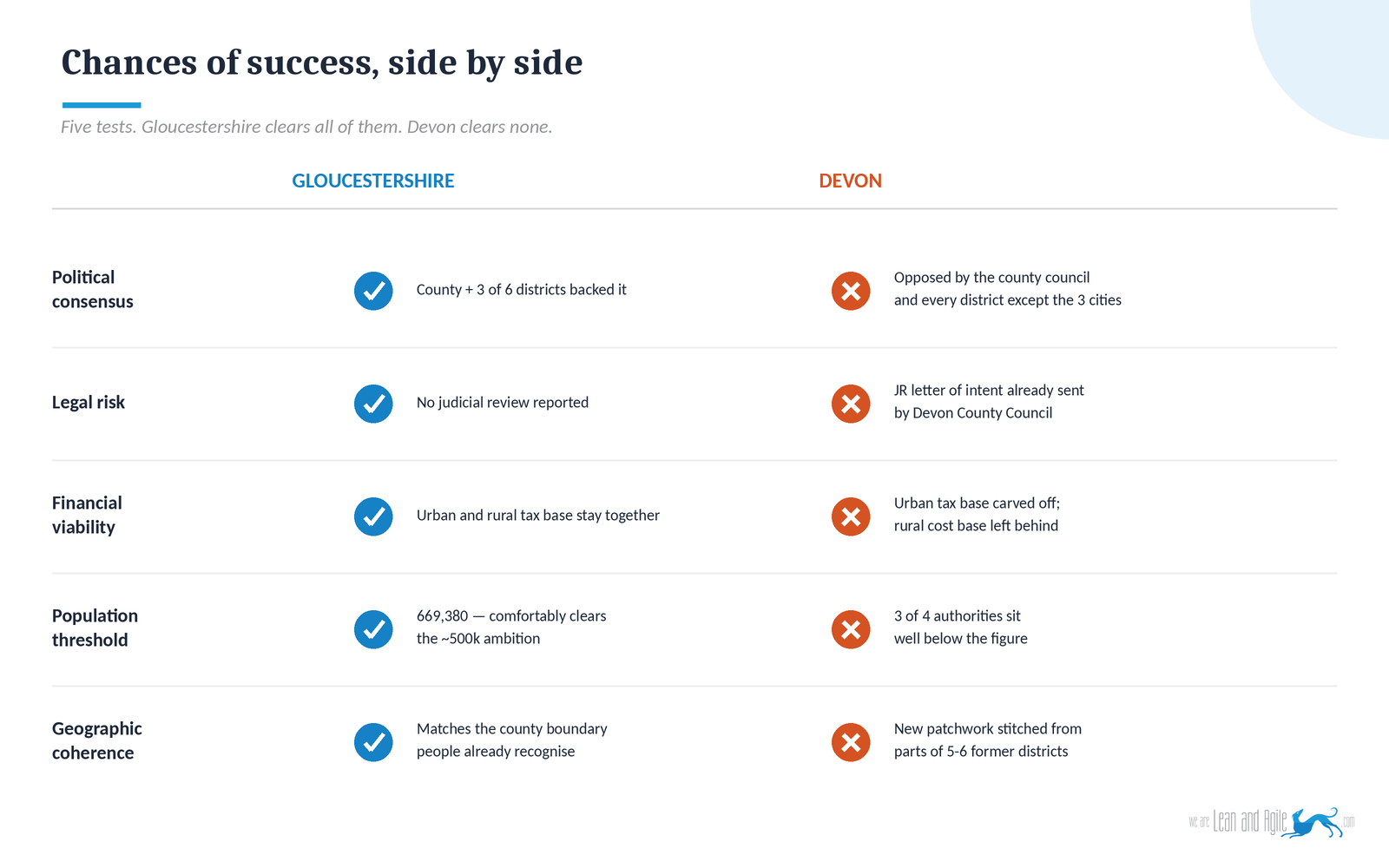
Gloucestershire clears every test. Devon clears none of them.
One more factor the scorecard doesn’t capture: Devon County Council is currently under government intervention for children’s services, working with an Expert Advisor and the Department for Education’s Children’s Services Commissioner. Reed’s decision letter explicitly flags this as something that will need careful handling through the transition, including keeping the specialist “Atkinson Unit” running through disaggregation. Splitting an authority mid-improvement-journey, into a structure that authority itself opposed, is not a small complication.
Everyone’s on the same team now — whether they wanted to be or not
There’s a detail in Reed’s decision letter that’s easy to miss and matters a great deal: implementation isn’t being split by new council. There will be “a single Implementation Team formed of officers from across the area” — meaning staff from Devon County Council, East Devon, Mid Devon, North Devon, Torridge, West Devon and the un-annexed remainder of South Hams and Teignbridge are now working alongside Exeter and Plymouth on delivering a plan those other councils spent the best part of a year publicly opposing.
The letter also reveals that Plymouth and Torbay had asked to use a “preparing council” model — effectively letting the expanding cities take the lead on transition planning without needing full new elections in the areas being annexed. Reed turned that down, on the record, because “this model has never been used for an expansion, and if used would lead to a democratic deficit that I do not think can be clearly and effectively mitigated.” So the government itself recognised a fairness risk in how much control the winning councils would otherwise have had — full shadow elections in May 2027 are partly a check on that.
None of this changes the underlying imbalance. The £400 million savings case belongs to Exeter and Plymouth. The county that didn’t want this outcome is now co-delivering it.
Nothing here is settled yet
Both decisions still need to survive whatever legal challenges follow, and both need a Structural Changes Order to pass through Parliament — expected in autumn 2026 — before either is legally real. Shadow elections are pencilled in for May 2027, with the new councils taking on full powers on vesting day, 1 April 2028.
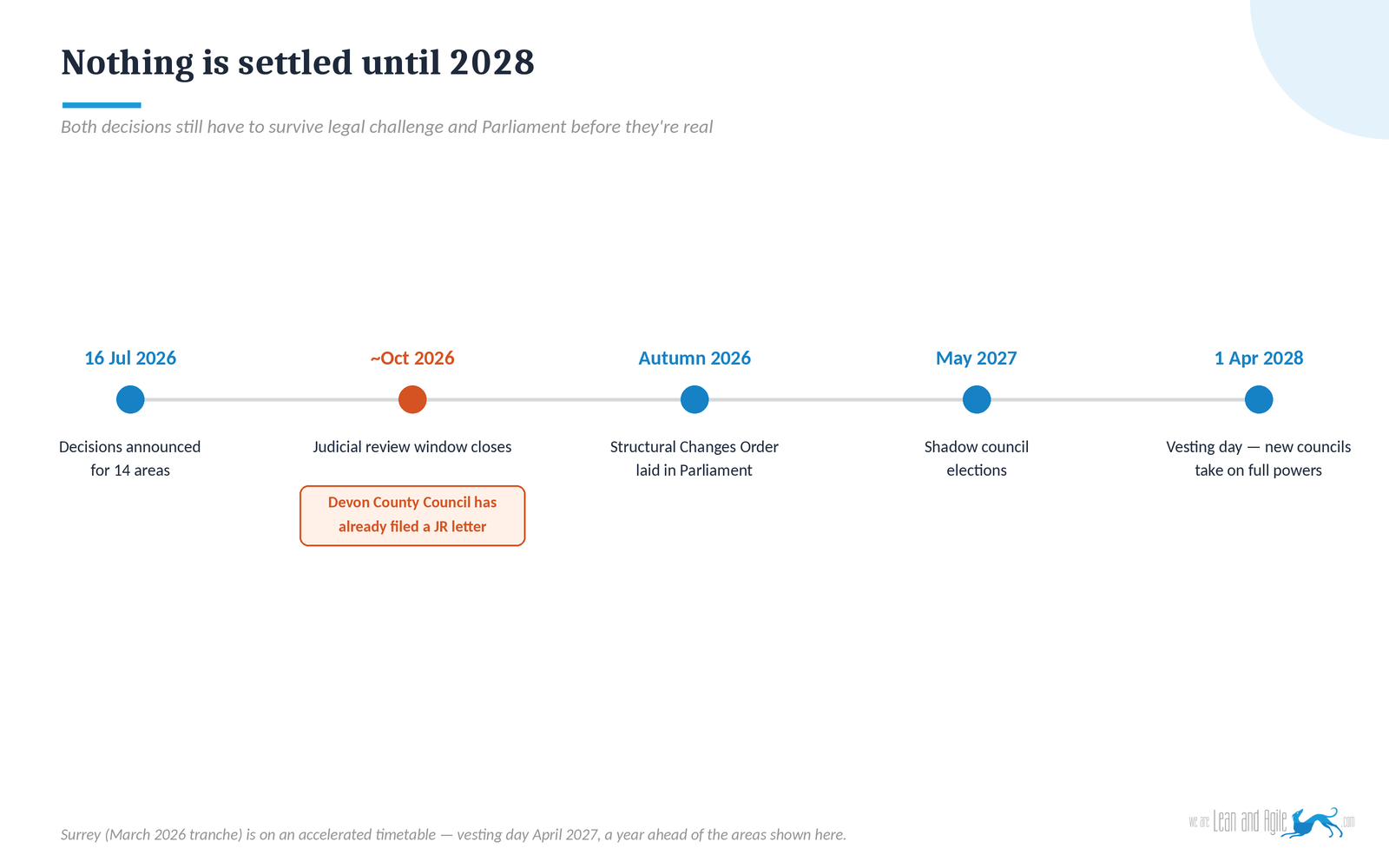
Devon’s judicial review letter means the clock is already running on a legal challenge before the structure is even in Parliament.
Gloucestershire looks likely to get there with relatively little drama. Devon is heading into a legal fight before it’s even properly begun, over a structure that its own county council says was chosen for political reasons rather than sound ones. Whichever authority you end up in on 1 April 2028, the geography is only the start of the job — but Devon Coast and Countryside is starting from a considerably harder position than Gloucestershire, with a fight over whether it even goes ahead as planned still to come.
Devon divides four ways and Gloucestershire stays whole, and the process work each faces is a different problem as a result. What that work actually consists of, and how to decide what to tackle first, is the subject of our free guide to process harmonisation through reorganisation.
We Are Lean and Agile are UK resellers and implementers of Engage Process — process mapping and management software used by councils across the country, including several going through reorganisation right now. If your area is heading into LGR and you want to talk through what the transition actually looks like at process level, get in touch.
Fact Notes
– Devon Coast & Countryside population is an estimate calculated from Devon’s total county population minus the areas reassigned to Plymouth, Exeter and Torbay
– Gloucestershire savings figures (£21m/yr, £164m/10yr) come from the proposal-stage business case, not a post-decision government figure