
The Map Is Settled. The People Aren't
What Comes Next for Devon’s Four New Councils.
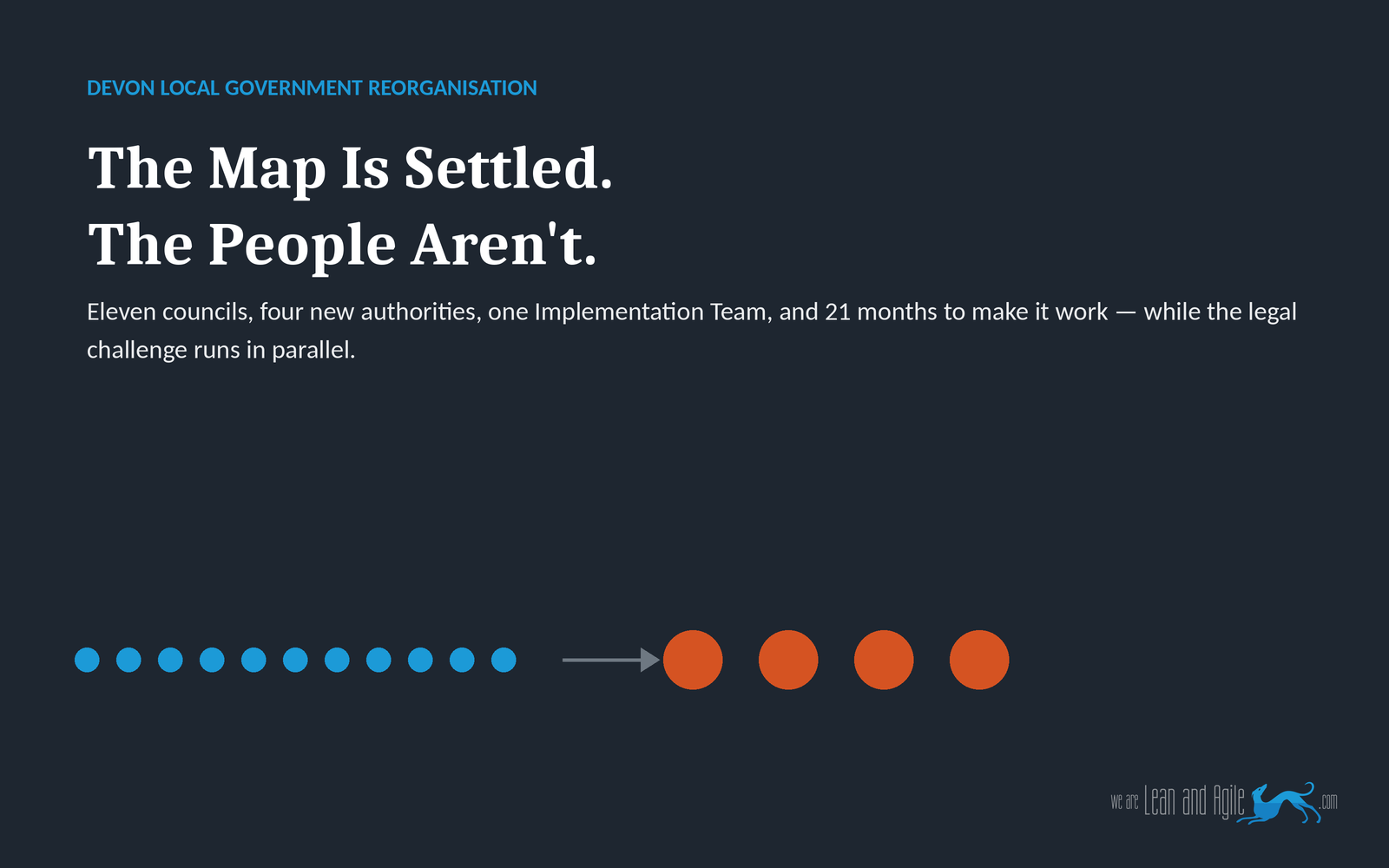
The decision on Devon’s shape was the easy part. Now eleven councils have to become four, on a fixed timetable, with a legal challenge running alongside the planning.
I’ve written twice now about the decision itself — how Devon ended up split four ways while Gloucestershire stayed whole, and what that says about the national savings case behind the whole reorganisation programme. Both pieces were about the decision. This one’s about what happens after it.
Because 16 July 2026 wasn’t the end of anything. It was the start of a 21-month process that has to turn eleven separate councils — each with their own staff, systems, budgets and, in some cases, strong feelings about how this all played out — into four working unitary authorities by 1 April 2028. And unlike Gloucestershire, where the winning option had broad backing before the decision was even made, Devon’s new councils have to do that work while one of their own constituent authorities is now formally pursuing a legal challenge against it.
That’s an unusual position to run a major organisational change from. Worth looking at what it actually involves.
The clock, properly this time
The dates get thrown around a lot in coverage of this, so here’s the sequence as it actually stands.
**16 July 2026** — decision announced. The four-unitary model is confirmed for Devon.
**3 August 2026** — Devon County Council sends its formal letter before claim to MHCLG — the first legal step towards judicial review, a little later than the “end of July” window originally flagged, but now under way. Cllr Julian Brazil: “I am not opposed to local government reorganisation. What I oppose is the Government choosing this solution… if that means a judicial review, then so be it.” Government has 14 days to respond, putting a reply due around 17 August.
**September 2026** — Devon CC’s cabinet decides whether to proceed to a full judicial review, based on how government responds.
**16 October 2026** — the outer legal deadline for formally launching judicial review proceedings, three months on from the original decision.
**Autumn 2026** — the Structural Changes Order is expected to be laid in Parliament, the legal instrument that actually creates the new councils.
**May 2027** — Shadow Authority elections. The shadow councils take on the detailed transition planning: budgets, senior appointments, the practical work of standing up four new organisations.
**1 April 2028** — vesting day. The new councils take on full legal powers and the old ones cease to exist.
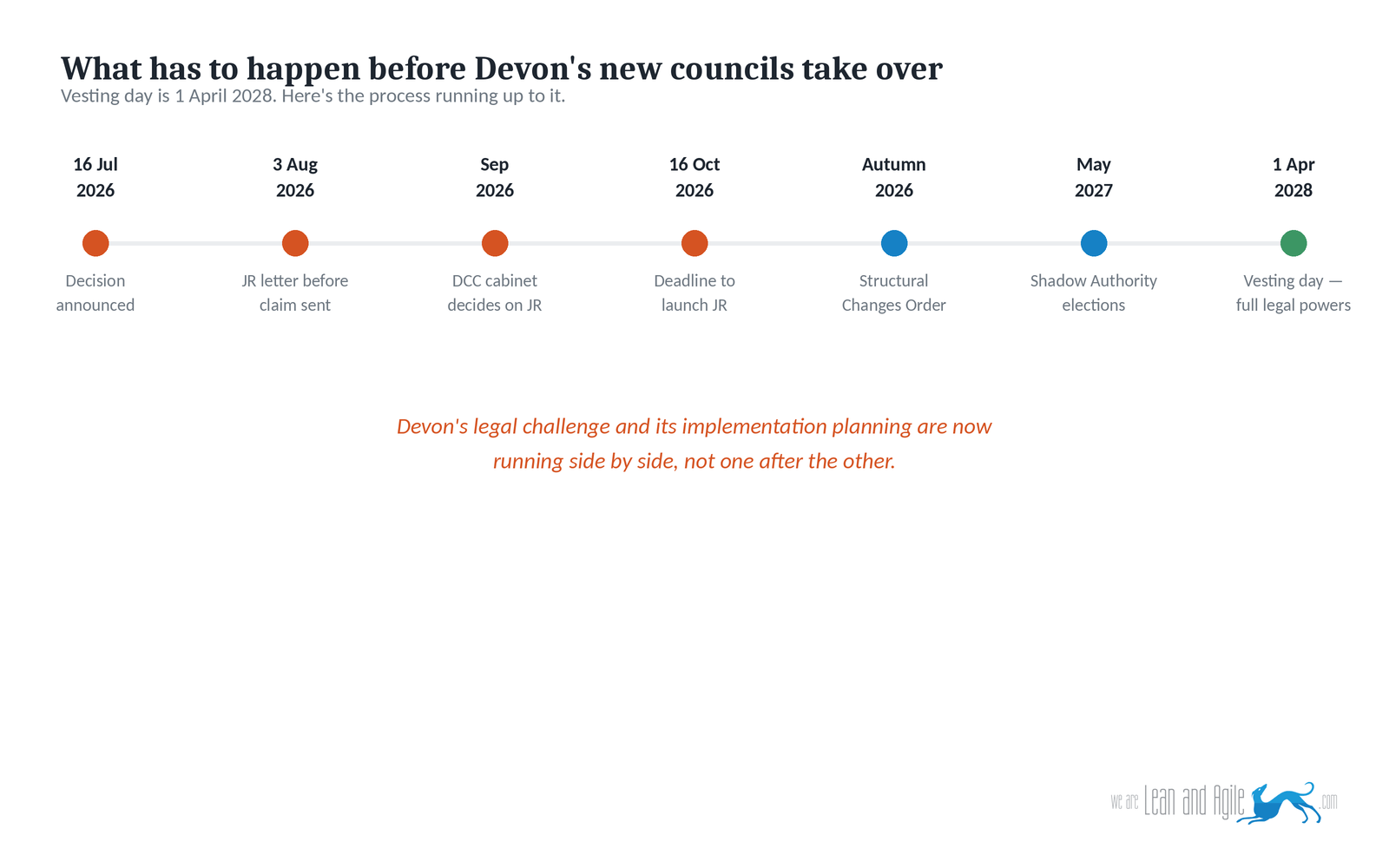
The thing that stands out from that list: the legal challenge and the delivery work aren’t sequential. Devon CC is expected to keep resourcing its share of a single shared Implementation Team through exactly the same months it’s deciding whether to sue the government over the plan that team is implementing. Green councillors on Torridge District Council have separately said they want a judicial review too. None of this stops the clock on the transition — it just means the transition is happening under contest.
One more wrinkle since the July decision: the government making it has changed hands. Steve Reed — who signed Devon’s decision letter, made the “guiding principle, not a fixed threshold” admission, and rejected the “preparing council” model — left government in a reshuffle around 20 July, when Andy Burnham became Prime Minister. Angela Rayner has returned as Secretary of State for Housing, Communities and Local Government, and it’s her department that now has 14 days to respond to Devon’s legal challenge. Cllr Brazil’s public statement already reflects this, calling directly on Rayner and the Prime Minister to reconsider the decision rather than on Reed. Nothing about the underlying decision has changed — the letter Reed signed still stands as the government’s position — but the person who has to defend it in correspondence, and potentially in court, is a different one now.
The consultation Devon actually ran
Before any of this gets framed as a communications problem, it’s worth being precise about what Devon’s own consultation found. Five proposals went to government. The option that won — Exeter and Plymouth’s joint expansion plan — was backed by just 20% of respondents. 69% were against it. Of the five options on the table, it ranked fourth.
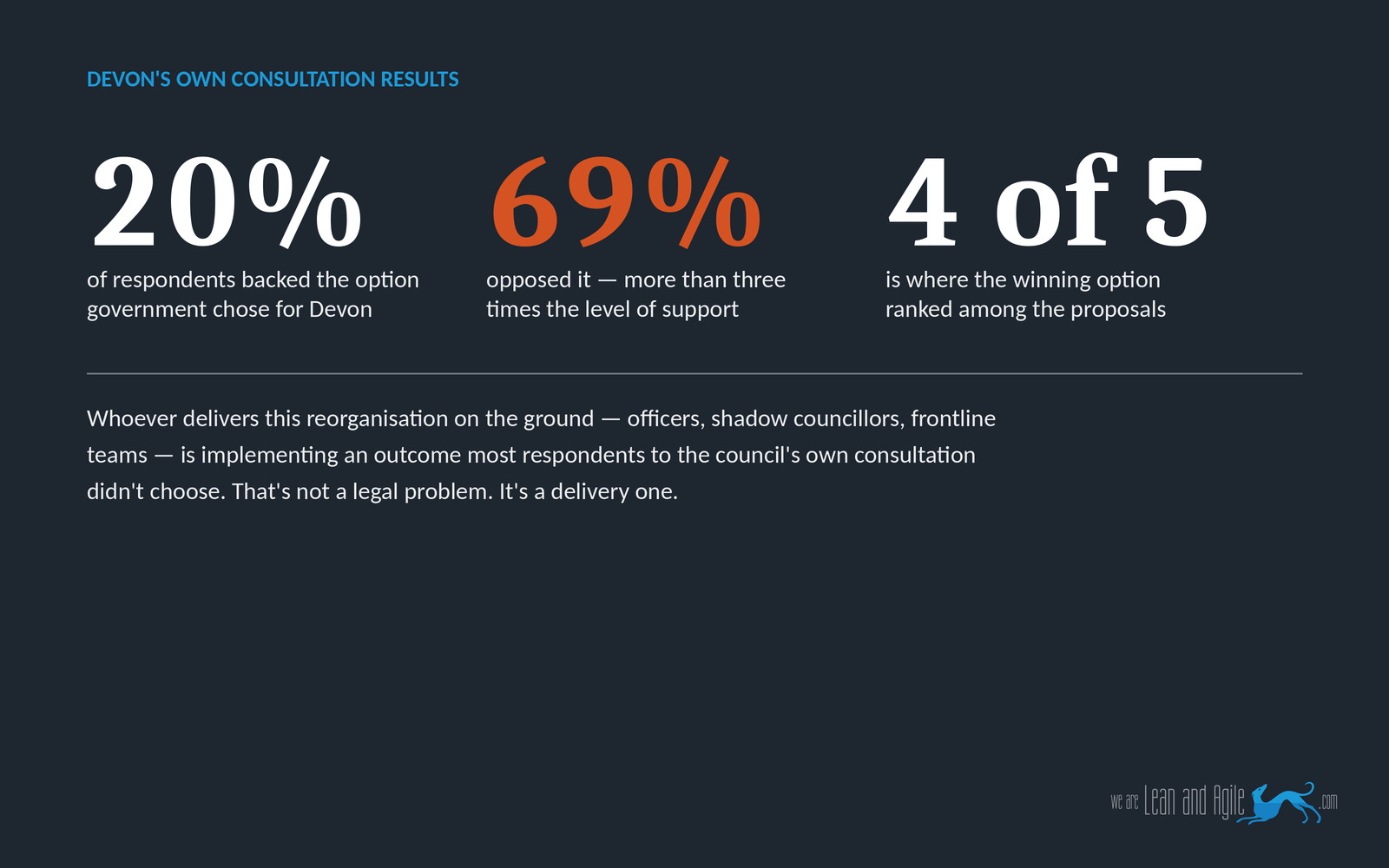
Government has always had the right to choose a different option to the one the public consultation favoured, and there were reasonable design arguments for the choice it made. But it’s worth being honest about what those numbers mean for delivery, not just politics. The officers, shadow councillors and frontline staff who have to make this work aren’t just managing a merger — they’re managing a merger that most of the people who responded to the council’s own consultation actively didn’t want. That’s not a legal argument. It’s a change management one, and it’s the kind of thing that shows up later as disengagement, slower decision-making and staff attrition if nobody names it early.
The money problem nobody’s promised to solve
While this piece was being drafted, a small but telling story broke that’s worth adding here, because it’s a live example of exactly the tension this piece is about — and it’s the same council mentioned above as pushing for its own judicial review.
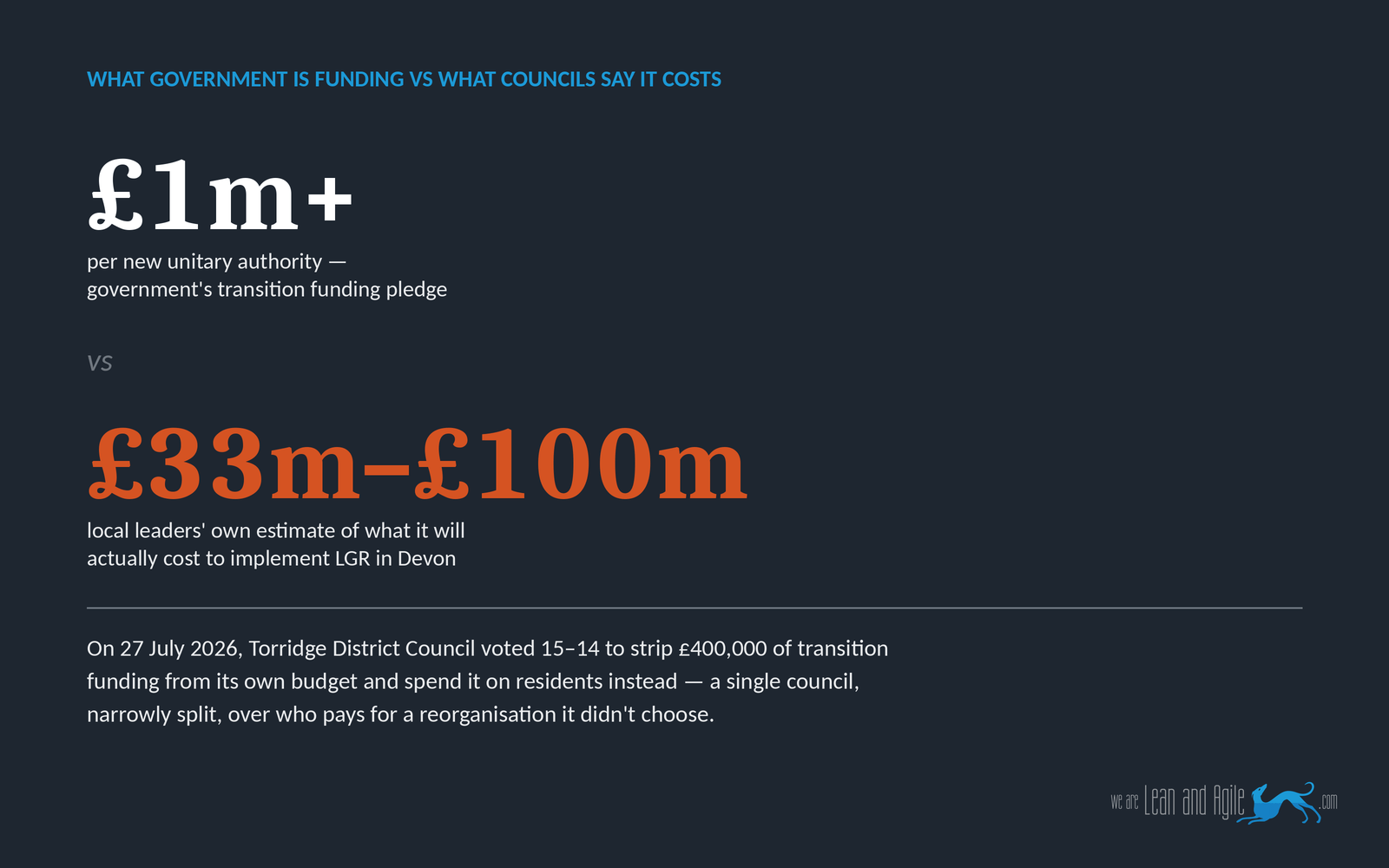
On 27 July 2026, Torridge District Council voted — narrowly, 15 to 14 — to strip £400,000 out of its own budget plans. That money had been earmarked from the council’s 2025/26 surplus to cover professional support and transition costs ahead of Torridge’s functions transferring to the new Devon Coast and Countryside authority in 2028. Councillors decided to spend it on local residents instead. Cllr Chris Bright, who proposed the change, put it plainly: “We all know it is going to be damaging to our area, if they (the government) want to do it they will have to pay for it.” Cllr Thomas Elliott added: “I was under the impression the government was going to pay the costs. Surely it would be better if we spent that money on local residents rather than something that is being forced upon us from higher up.”
It wasn’t unanimous. Cllr Nigel Kenneally voted to keep the money aside, and made the opposing case afterwards: “The government are imposing LGR on us in Devon… the decision has been made, so I believe we have to get our heads down and make the best of it for the people we represent… it is estimated that LGR is going to cost between £33 and £100m to implement in Devon and there isn’t a chance that the government is going to fully fund it. So I believe we have to do our bit to give us the best chance of making a good go of this abysmal decision.” Torridge’s own chief executive, Steve Hearse, told the meeting the £400,000 figure was only ever indicative, and the real cost was likely to be higher.
That’s a single district council, in a single vote, splitting almost down the middle on whether to fund its own share of a transition it has no power to stop. Multiply that dynamic across eleven councils and it’s not hard to see how implementation planning turns into a funding negotiation as much as a delivery one — especially set against the numbers underneath it: government has said each area undergoing reorganisation will receive just over £1 million per new unitary authority created, which for Devon’s four new councils is a low-single-digit-million pot. Local leaders’ own estimate of what it will actually cost to implement LGR in Devon runs to somewhere between £33 million and £100 million, depending on who’s doing the estimating.
Worth being clear that this is a different figure entirely from the £400 million savings claim discussed above — that’s the projected benefit once the new councils are running. This is what it costs just to build them in the first place, and on the numbers currently in public view, there’s a large gap between what government has committed to fund and what councils on the ground think the job will actually require.
Three councils, three very different starting points
It’s tempting to describe this as Exeter and Plymouth against Devon County Council, but that flattens something worth keeping distinct: the three authorities directly involved in the winning proposal went into 16 July from three genuinely different positions.
**Exeter and Plymouth** proposed this outcome and got it. Their joint submission is the blueprint the government adopted, savings claims and all. They’re now leading delivery of a plan they designed.
**Torbay** didn’t. Its own submission to government was to keep its existing boundaries — no expansion, no change. That’s not what happened: Torbay is gaining 21 parishes carved out of Teignbridge and South Hams. Leader Cllr David Thomas was candid about it: “Our submission to Government was for Torbay to stay the same… This isn’t the result we wanted but I recognise that Government has made their decision and here in Torbay we will embrace this change.” Torbay lost its own argument and is choosing to co-operate anyway.
**Devon County Council** also didn’t get what it proposed — a single “One Devon” unitary keeping the existing county boundary intact — and it’s taking the opposite approach to Torbay. Leader Cllr Julian Brazil called the outcome “blatant gerrymandering” and the council is actively pursuing legal action.
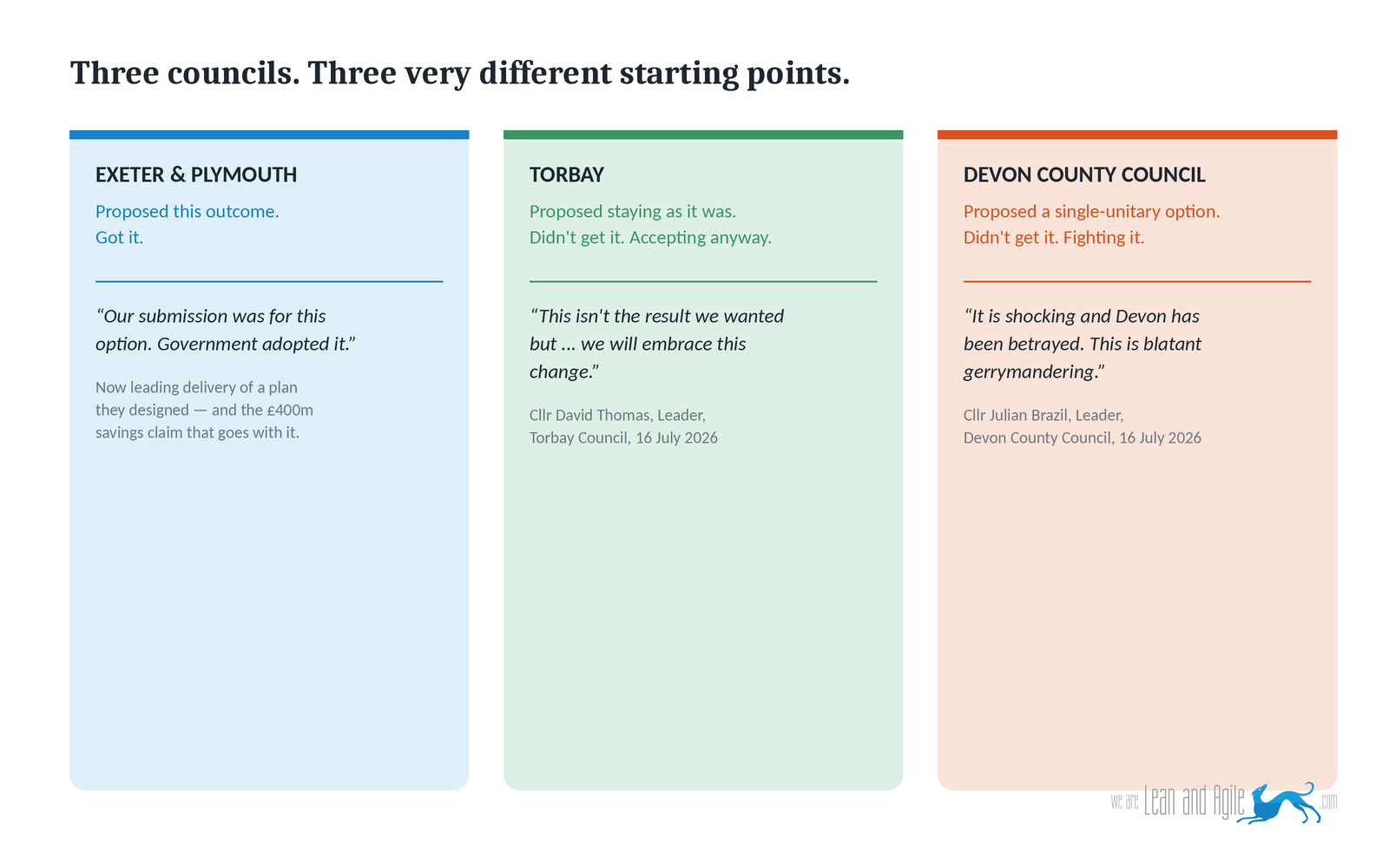
That’s three different relationships to the same outcome, sitting inside the same shared delivery structure. Worth remembering the next time “Devon’s reorganisation” gets talked about as a single, unified programme — right now it’s closer to three separate reconciliation processes running at once, each with a different level of trust in the outcome.
One Implementation Team, several different starting positions
Steve Reed’s decision letter is explicit that Devon won’t get four separate transition teams working in parallel. There’s a single Implementation Team, formed of officers from across the area — meaning staff from Devon County Council, East Devon, Mid Devon, North Devon, Torridge, West Devon, and the un-annexed remainder of South Hams and Teignbridge are now working alongside their counterparts from Exeter and Plymouth on delivering a plan several of those councils spent the best part of a year publicly opposing.
Some reporting suggests deputy implementation leads are being appointed for each of the four new authorities, with Torbay and Plymouth’s existing chief executives expected to lead their own areas given they’re already running functioning unitary organisations, while arrangements for Exeter and the new Devon Coast and Countryside authority are still being worked out locally. If accurate, that’s a structural head start for the two councils that already had unitary-scale leadership in place before any of this began — worth checking directly with Devon County Council or the Implementation Team once formal appointments are confirmed, since it wasn’t detailed in the primary decision letter itself.
Reed’s letter does confirm one other important structural decision: Plymouth and Torbay had asked to use a “preparing council” model, which would have let the expanding cities take the lead on transition planning without full new elections in the areas being annexed. Reed turned that down — on the record — because “this model has never been used for an expansion, and if used would lead to a democratic deficit that I do not think can be clearly and effectively mitigated.” Full shadow elections in May 2027 across all four new authorities are, in part, a direct response to that concern.
Whose savings target is it, anyway?
I’ve written before about the gap between Exeter and Plymouth’s published claim of “over £400 million in savings” and Steve Reed’s own decision letter, which endorses the option only as one that’s “likely to perform similarly or represent an overall improvement in sustainability” — considerably softer than the number attached to the proposal it approves.
That gap matters even more once you think about who actually has to live with the number. Exeter and Plymouth put the £400m and £58m Net Annual Benefit figures in their own proposal, which means those figures are likely to end up baked into their own medium-term financial plans once the new authorities are up and running — a target they set for themselves and will be judged against.
Devon Coast and Countryside doesn’t have that problem. It also doesn’t have that opportunity. Nobody proposed a business case with a savings figure attached for the authority that’s inheriting the rural leftovers of five or six districts, spread across roughly 2,500 square miles and 110 miles end to end, with a population density of around 124 people per square kilometre — compared with Plymouth’s 3,311. That’s not a rounding difference. It’s a fundamentally different cost base for delivering the same statutory services, and the one authority built from a proposal nobody separately costed is also the one with the hardest geography to serve.
Put simply: two of Devon’s four new councils are walking in with a specific financial target attached to their name. The other two — Torbay and Coast and Countryside — aren’t, which cuts both ways. No number to hit, but also no plan built around their actual shape.
The risk that’s easy to miss in a story about maps
One part of this rarely makes the coverage about boundaries and business cases, and it’s arguably the most consequential. Devon County Council’s children’s services are currently rated ‘Inadequate’ by Ofsted and under active government intervention, working with an Expert Advisor and the Department for Education’s Children’s Services Commissioner.
That commissioner, Nigel Richardson CBE, warned in a report before the July decision that local government reorganisation was one of his two biggest concerns for the service’s ongoing improvement. His words: anything that “breaks” the positive trajectory already under way would “risk stopping the existing work in its tracks with an even bigger risk that things would quickly slip backwards.” Reed’s decision letter acknowledges this directly, flagging the need to keep the specialist “Atkinson Unit” running through disaggregation.
That’s a live, monitored, high-stakes service — currently improving, currently being watched by central government for exactly that reason — being split across a structural reorganisation that its own overseer warned about in advance. Whatever else goes right or wrong with the org charts and the savings targets, this is the one part of the transition where getting it wrong has consequences that show up in real children’s lives, not just spreadsheets.
What actually determines whether this works
Strip away the politics and Devon’s situation is a fairly textbook large-scale organisational change: multiple predecessor organisations, each with their own processes, systems and culture, being asked to converge on four new ways of working, on a fixed deadline, with senior positions still to be filled and no shared starting level of trust in the plan.
The structural decisions — who leads what, which systems get kept, which get retired — will get made either deliberately, through a proper look at how each predecessor council actually does things day to day, or by default, because whichever system happened to belong to the biggest or best-resourced predecessor organisation is the one still standing when the dust settles. The second approach is faster in the short term and consistently more expensive in the long term, because it means inheriting somebody’s workarounds rather than designing a process that fits four different areas’ actual needs.
That’s the practical, unglamorous work behind every reorganisation success story and every reorganisation horror story: not the political fight over the map, but whether anyone did the unsexy job of mapping out how services actually get delivered before deciding how the new organisation should run them.
The capture problem described here has no owner by design, and the window closes on 1 April 2028. There is a fuller treatment of it, along with the register, the triage and the sequencing, in our free guide to process harmonisation through local government reorganisation.
We Are Lean and Agile are UK resellers and implementers of Engage Process — process mapping and management software already used by councils across the country, including several going through reorganisation right now. If you’re one of the officers who has to turn eleven councils’ worth of ways of working into four, we’d be glad to talk about what that actually looks like at process level. Get in touch.
**Sources:**
– Decision letter from Rt Hon Steve Reed OBE MP to Devon, Plymouth and Torbay council leaders, 16 July 2026]
– Devon’s judicial review challenge against new council plans — Ivybridge & South Brent Gazette / South Hams Today, 24 July 2026 — source for the consultation figures, population density stats, Nigel Richardson quote, and JR timeline
– Local Government Reorganisation decision announced — Torbay Council, 16 July 2026 — source for Cllr David Thomas’s quote and the shadow authority/vesting day timeline
– Devon LGR — official multi-council information site
– Three counties consider LGR judicial reviews — Local Government Chronicle
– ‘They will have to pay’ — Torridge refuses to fund council shake up — North Devon Gazette, 30 July 2026 — source for the £400,000 vote, the £33m–£100m cost estimate, the £1m-per-unitary funding figure, and all councillor quotes in the “money problem” section
– Government facing judicial review over Devon reorganisation — Local Government Lawyer, 4 August 2026 — source for the 3 August letter before claim, the 14-day response window, and Cllr Brazil’s latest quote
– Angela Rayner returns as Secretary of State for Housing, Communities and Local Government — Local Government Lawyer, 20 July 2026 — source for the ministerial reshuffle
– Steve Reed leaves government — Local Government Chronicle, 20 July 2026 — corroborating source for the reshuffle