
Nobody Checked the Sums. The Shapes Being Approved Don't Match the Story.
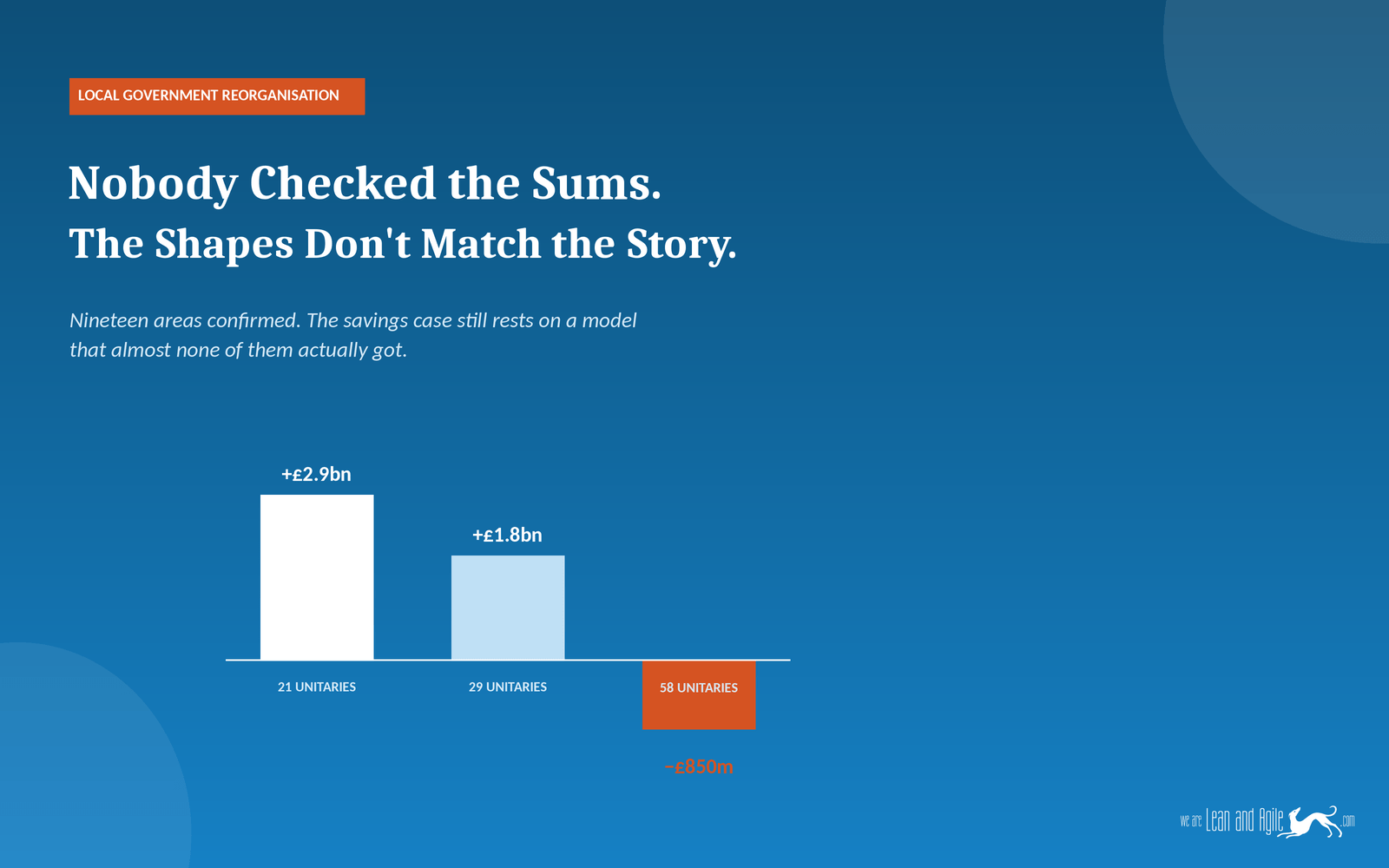
Nineteen areas have now had their local government reorganisation confirmed. The savings case for all of them still rests on a model that most of them don’t actually fit.
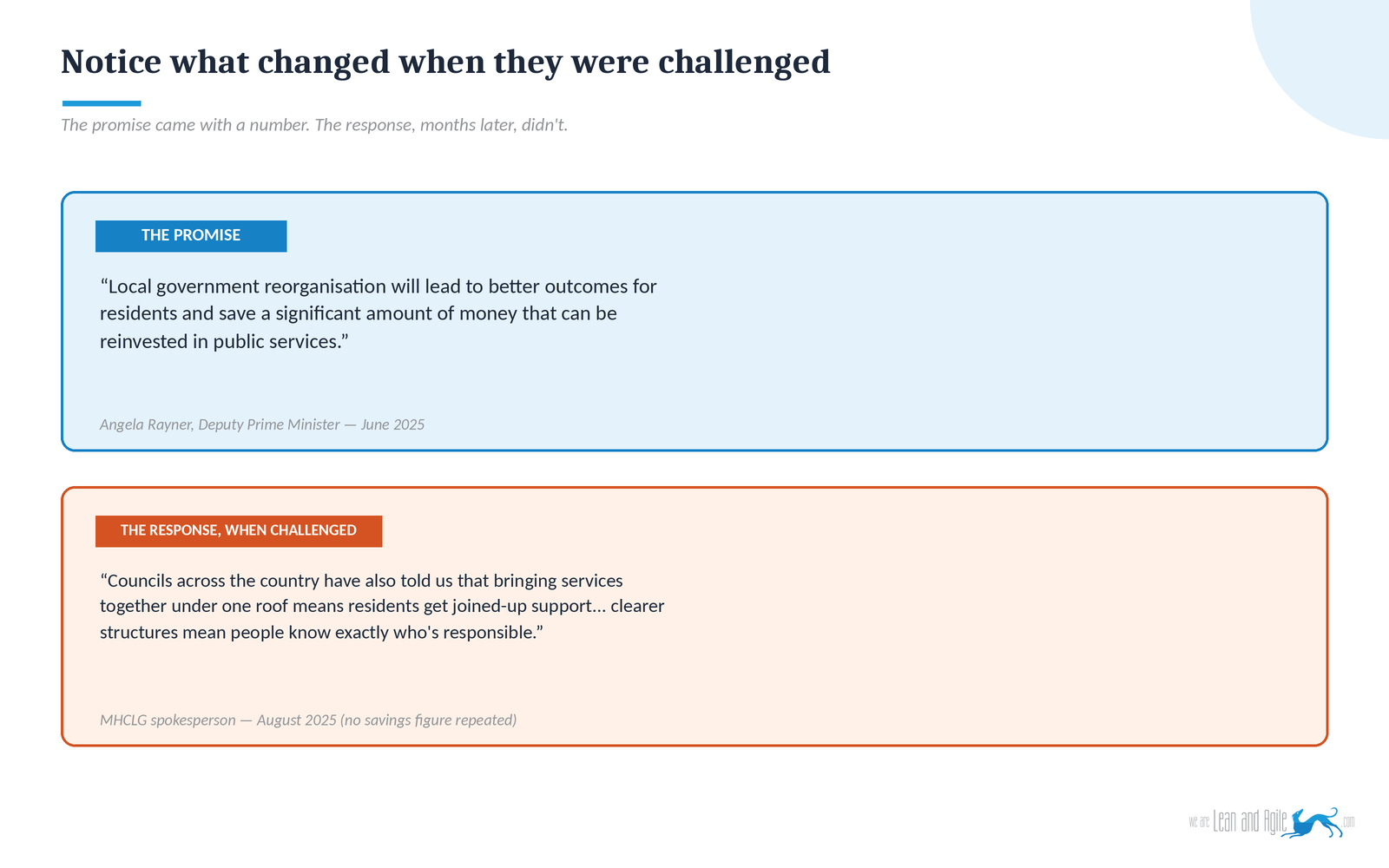
Back in June 2025, Deputy Prime Minister Angela Rayner told MPs that local government reorganisation “will lead to better outcomes for residents and save a significant amount of money that can be reinvested in public services.”
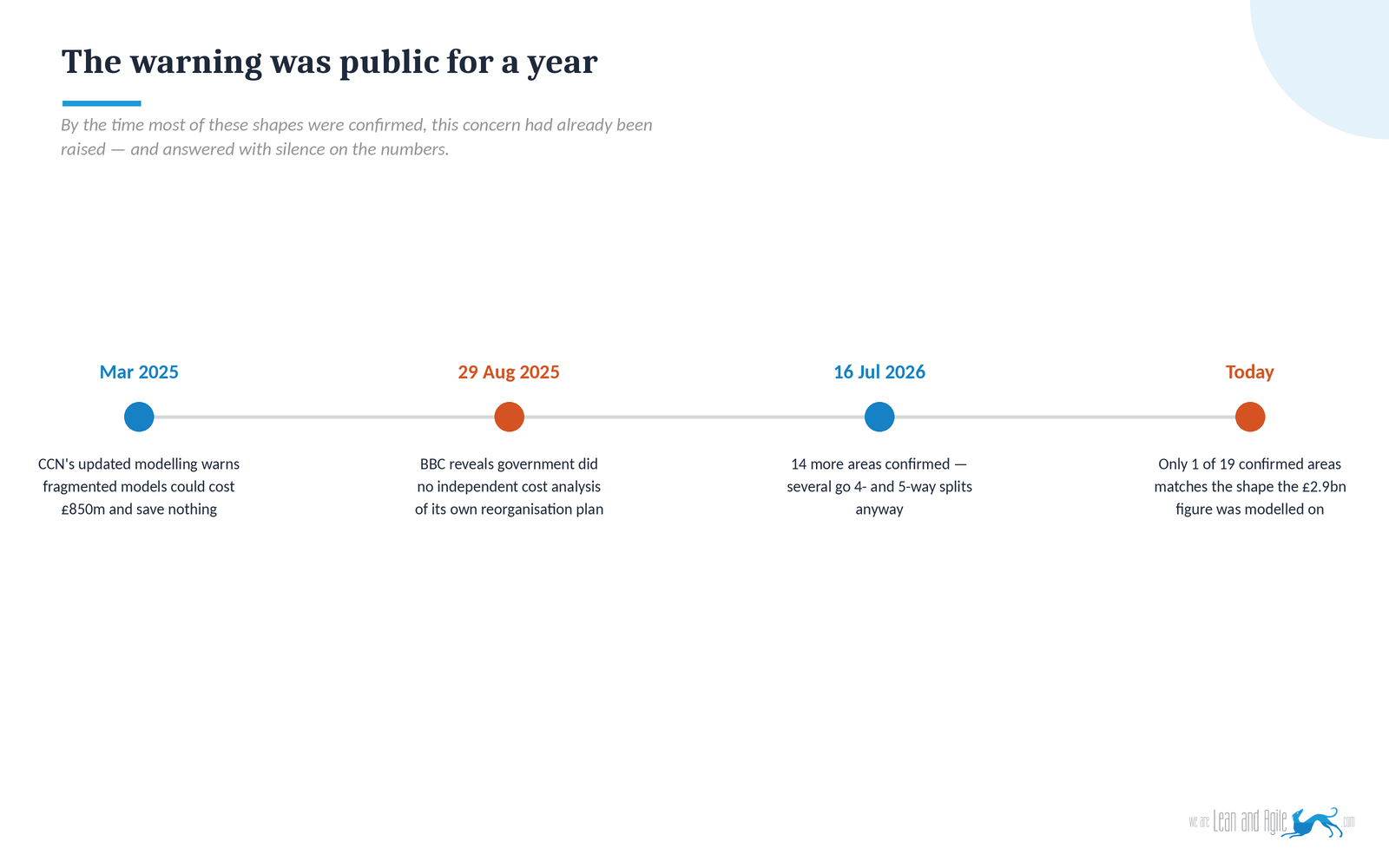
Two months later, the BBC found out via a freedom of information request — that her department had never checked whether that was true. No in-house cost analysis was done. The government’s savings case rested entirely on a 2020 report commissioned by the County Councils Network (CCN) — a cross-party lobby group for county authorities — modelled by PwC.
That report said £2.9 billion could be saved over five years. But there’s a detail that keeps getting dropped whenever that figure gets quoted: it only holds if every one of the 21 two-tier areas being reorganised becomes a single unitary authority.
That story broke in August 2025 — nearly a year before the July 2026 batch of decisions this blog has been covering. Which makes what’s happened since more pointed, not less: government had this warning on the record for the best part of a year, and still went on to approve some of the most fragmented shapes in the whole programme.
Almost none of the 19 confirmed areas are getting the single-unitary shape the £2.9 billion figure was built on.
What the modelling actually says
PwC’s analysis, updated by the CCN in March 2025, isn’t a single number — it’s three scenarios, and the difference between them comes down entirely to size and how many pieces each county gets split into.
**Scenario one: 21 single unitaries.** Every two-tier county becomes one authority. Savings: £2.9 billion over five years.
**Scenario two: 29 unitaries, all above 500,000 people.** A few counties split into two where the population supports it, but every new authority still clears the government’s own stated threshold. Savings: £1.8 billion over five years.
**Scenario three: 58 unitaries, as small as 300,000 people.** Full fragmentation — most counties split three, four, even five ways. Result: a cost of £850 million over five years, and no long-term savings at all. The CCN’s own words: “no long-term efficiency savings would be delivered, meaning it would be more efficient to retain the current two-tier system in England.”
Tim Oliver, the CCN’s chairman — whose organisation produced the figure the government is relying on — put it plainly: splitting counties into unitaries “as small as 300,000 will create hundreds of millions of new unsustainable costs for local taxpayers.”
So the £2.9 billion isn’t a floor. It’s the best case, and it depends on a version of reorganisation that isn’t what’s actually being approved.
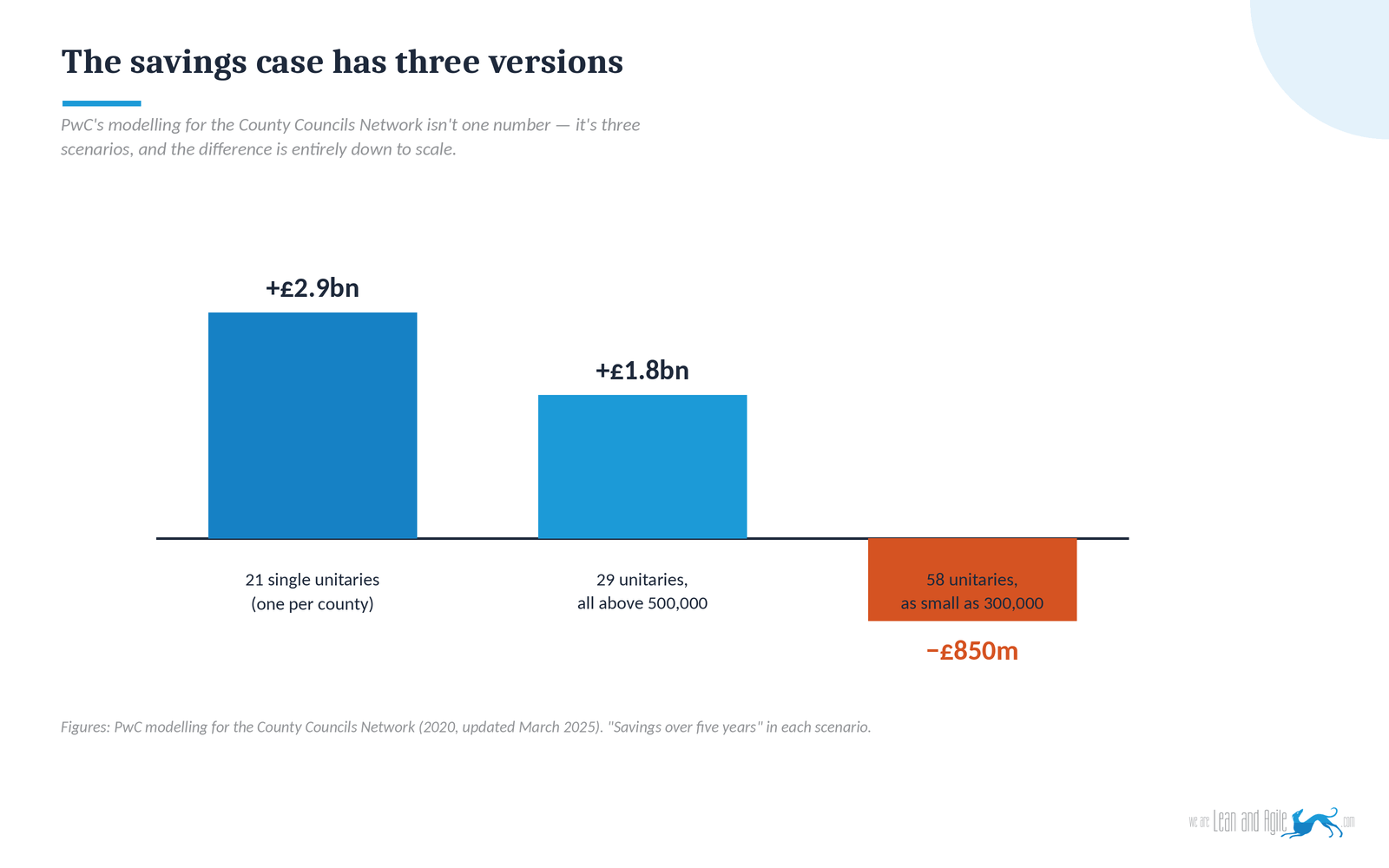
Same modelling exercise, three very different outcomes — and the difference is entirely down to scale.
What’s actually being approved
Nineteen areas have had their reorganisation confirmed so far — five in March 2026, fourteen more in July. Here’s how many unitary authorities each one is getting.
Same programme, same criteria, same government — a spread from one authority to five.
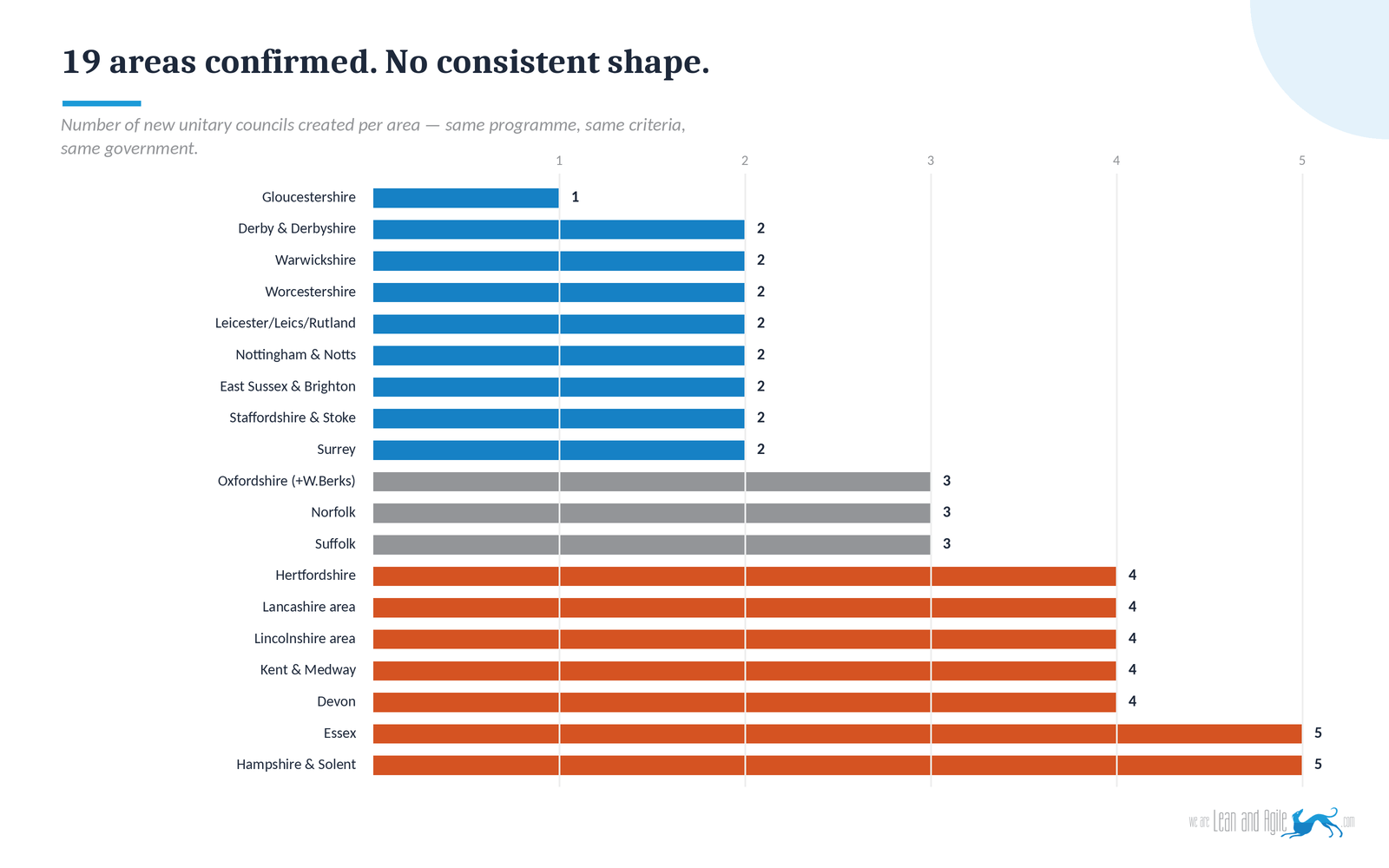
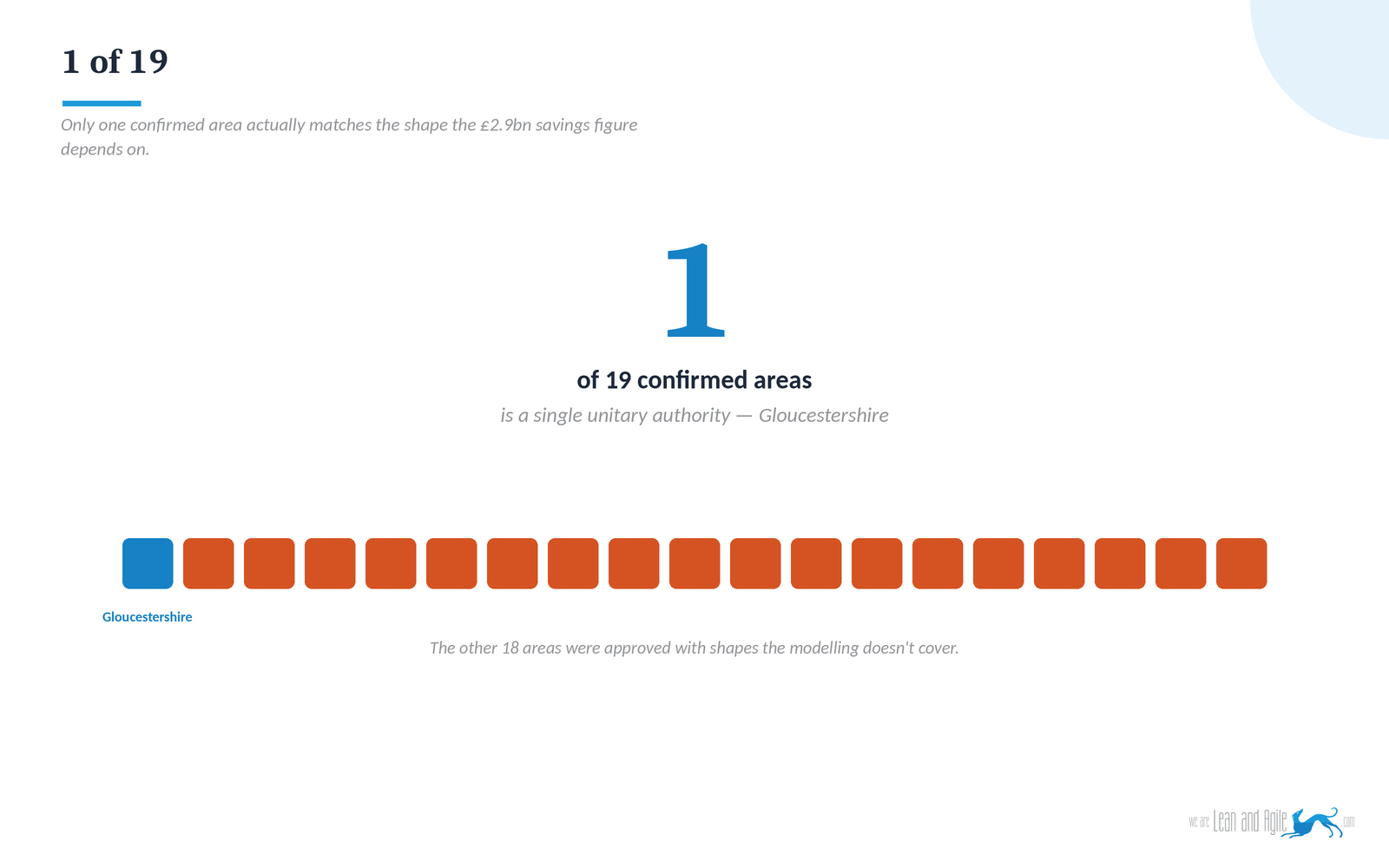
One area landed on Scenario One. The rest sit somewhere between Scenario Two and Scenario Three — and several of them, Essex and Hampshire among them, are at the fragmented end where the CCN’s own modelling says the savings case weakens sharply or disappears.
Local Government Chronicle’s analysis of the July decisions found the same pattern in the population numbers directly: the new unitaries confirmed so far range from 160,000 people (North East Lincolnshire) up to 683,000, and roughly two-thirds of them miss the government’s original “around 500,000” ambition. Gloucestershire, at 669,380, is one of the few that clears it comfortably. Most don’t.
It’s not just that the numbers miss the mark — the government has now said, in writing, that it never expected them to hit it. Steve Reed’s own decision letter approving Devon’s reorganisation states plainly that “all the new councils would be below the 500,000 population figure” and that the figure “has always remained a guiding principle, not a fixed threshold.” That’s not a one-off admission about one county. It’s the Secretary of State confirming, in the document explaining his own decision, that the headline criterion his department published was never binding on any of the 19 areas above — which makes the LGC’s “two-thirds miss the threshold” finding look less like a series of individual shortfalls and more like the predictable result of a target nobody was actually holding anyone to.
This isn’t one area doing it wrong. It’s most of them doing it differently.
I wrote earlier in the week about Devon, where the government approved a four-way split that the county council itself is now taking to judicial review, against a Gloucestershire decision that kept the whole county together and had broad local backing. At the time, that looked like a specific, local story — one area where the politics of who submitted the winning business case mattered more than the underlying logic.
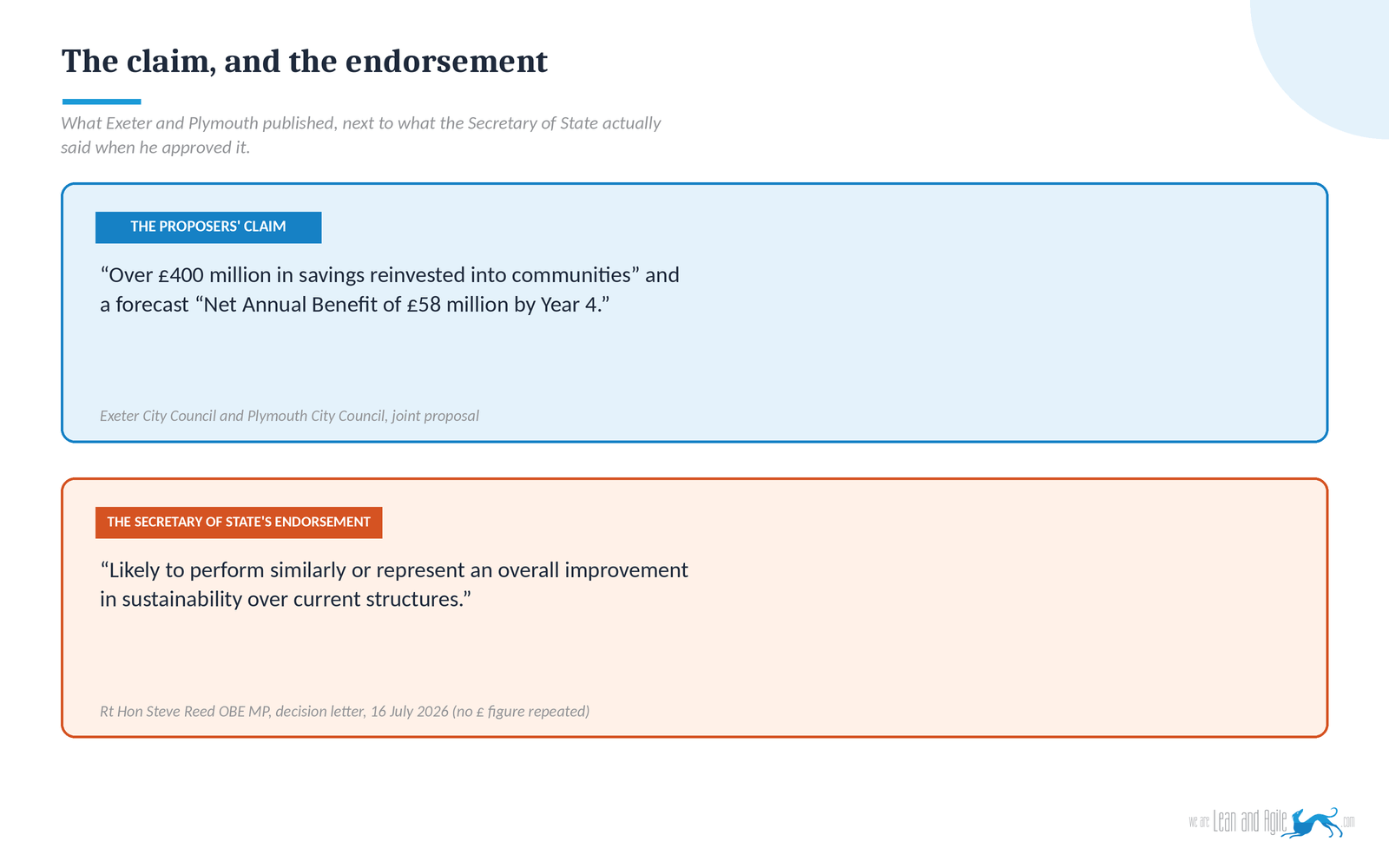
Reading Devon’s actual decision letter made it look like less of a one-off. Exeter and Plymouth’s winning proposal claims “over £400 million in savings” and a £58 million Net Annual Benefit by Year 4 — a specific, confident number, published by the councils that put the proposal together. Steve Reed’s letter approving it doesn’t repeat that figure anywhere. His own assessment is that the option is “likely to perform similarly or represent an overall improvement in sustainability” — considerably softer language than the number attached to the proposal it’s approving. And the letter says he “considered the expected costs and benefits set out in the options,” which is a fairly plain way of confirming that the £400 million came from the councils themselves, not from independent verification. That’s the same pattern the BBC uncovered nationally almost a year earlier, playing out in a live 2026 decision document: government approving a reorganisation on the strength of savings figures it didn’t produce and doesn’t fully endorse.
Look at the national table and it stops looking like an isolated case. Essex is going five ways. Hampshire is going five ways. Kent, Lancashire, Lincolnshire and Hertfordshire are all going four ways. Only Gloucestershire got the single-unitary shape the £2.9 billion figure is actually built on.
If reorganisation were being applied as a consistent, evidence-led formula — find the right size, apply it everywhere — you’d expect most areas to land in a similar place, adjusted for population and geography. Instead there’s a spread from one authority to five, area by area, apparently settled more by which local coalition put together the most politically workable proposal than by any single design principle running through the whole programme.
That’s not a formula being rolled out. That’s nineteen separate local negotiations, running in parallel, each producing whatever shape the loudest or best-organised local interests could agree on — with a national savings figure attached to the outcome that was actually modelled on a completely different, tidier version of the same idea.
The rare moment everyone agreed
What’s striking about the BBC’s August 2025 story is how many different people, from different sides, reacted the same way — a year before most of these shapes were even confirmed.
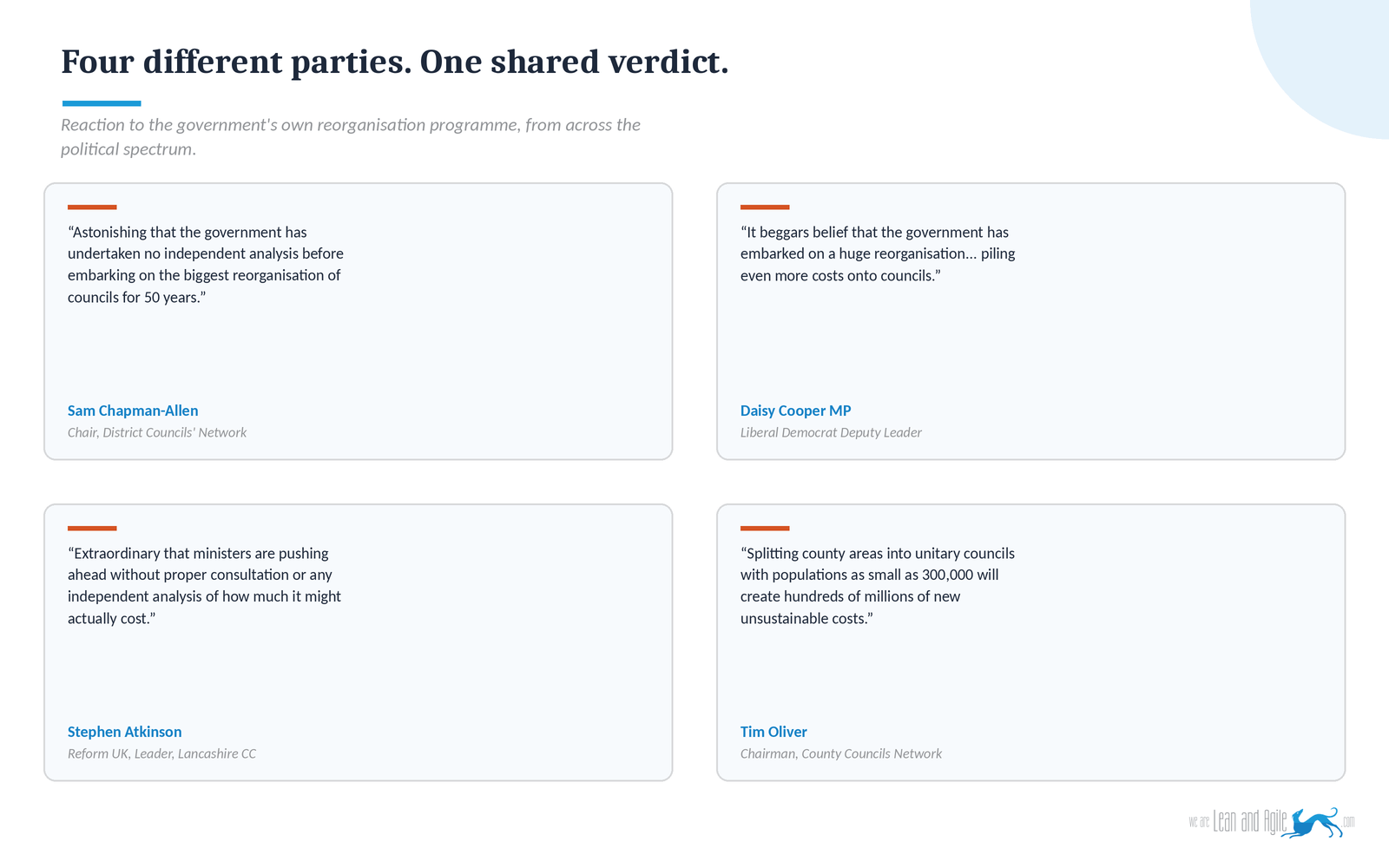
Sam Chapman-Allen, chair of the District Councils’ Network, called it “astonishing that the government has undertaken no independent analysis before embarking on the biggest reorganisation of councils for 50 years.” Liberal Democrat deputy leader Daisy Cooper said it “beggars belief” that reorganisation was proceeding in a way that “piles even more costs onto councils, whose finances are already on the brink.” Stephen Atkinson, Reform UK’s leader of Lancashire County Council — one of the four-way splits in the table above — called it “extraordinary” that ministers were pushing ahead “without either proper consultation or any independent analysis of how much it might actually cost.”
District council leaders, Liberal Democrats, Reform, and the county council lobby group that supplied the original figures are not natural allies. On this specific point, they’re saying the same thing.
MHCLG’s response to the BBC didn’t defend the £2.9 billion figure. It shifted the argument: “Councils across the country have also told us that bringing services together under one roof means residents get joined-up support when they need it most, while clearer structures mean people know exactly who’s responsible for delivering their services.” That’s a service-quality argument, not a financial one. Worth noticing that the department didn’t restate the savings case when directly challenged on it — it moved to different ground.
What this actually means if you work in one of these councils
Whichever of the nineteen shapes your area landed on, the honest starting position is this: the specific savings figure attached to your reorganisation was very likely never modelled for your actual outcome. It’s a number borrowed from a best-case scenario that assumed a different, more consolidated structure than the one you’re getting.
If your area landed close to Scenario One — one authority, comfortably over 500,000 — you’re in the best position the modelling describes, and there’s a real efficiency case to chase. If your area is one of the four or five-way splits, the honest read of the government’s own evidence base is that the savings case is thin, contested, or possibly negative, and nobody in government has done the work to say otherwise for your specific area.
Either way, the structural change was never going to deliver savings on its own — the PwC modelling makes that explicit even in its best-case scenario, since £2.9 billion assumes the reorganisation is “delivered at the right scale,” in Tim Oliver’s words, not just delivered. Scale creates the conditions. The transformation work — finding where two, three or four predecessor councils are doing the same job differently, and standardising on the best of it — is what actually closes the gap between the shape on paper and the savings in the budget.
That work matters more, not less, in the fragmented outcomes. If your new council is one of four or five carved out of a county that used to be one system, you have more predecessor ways of working to reconcile, a smaller organisation to do it with, and — per the CCN’s own numbers — a national evidence base suggesting the underlying economics were never strongly in your favour to begin with.
If the arithmetic in your area looks closer to the third scenario than the first, the savings will have to come from redesigning services rather than from the merger. Same Service, Five Different Ways is a free 36-page guide to that work, including how to evidence savings against a target you didn’t write, and why the baseline has a deadline.
We Are Lean and Agile are UK resellers and implementers of Engage Process — process mapping and management software used by councils across the country, including several going through reorganisation right now. If your area’s savings case depends on transformation work that hasn’t started yet, get in touch.
Sources for this piece
– “Ministers didn’t do cost review of council mergers” — BBC News, 29 August 2025
– Government skipped own cost review of council mergers — LocalGov.co.uk, 29 August 2025
– Government skipped own cost review of council mergers — The MJ, 29 August 2025 paywalled after the intro, but confirms the same story and date
– New unitary councils to be created must cover ‘at least’ 500,000 people — Government Business
– Two-thirds of new unitaries miss 500,000 threshold — Local Government Chronicle