
LGR Will Not Save You Money. Your Processes Will.
Local Government Reorganisation promises billions in efficiency savings — but only if councils do the hard work of fixing how they actually operate. Here’s what the first wave of mergers teaches us, and a practical way to start.
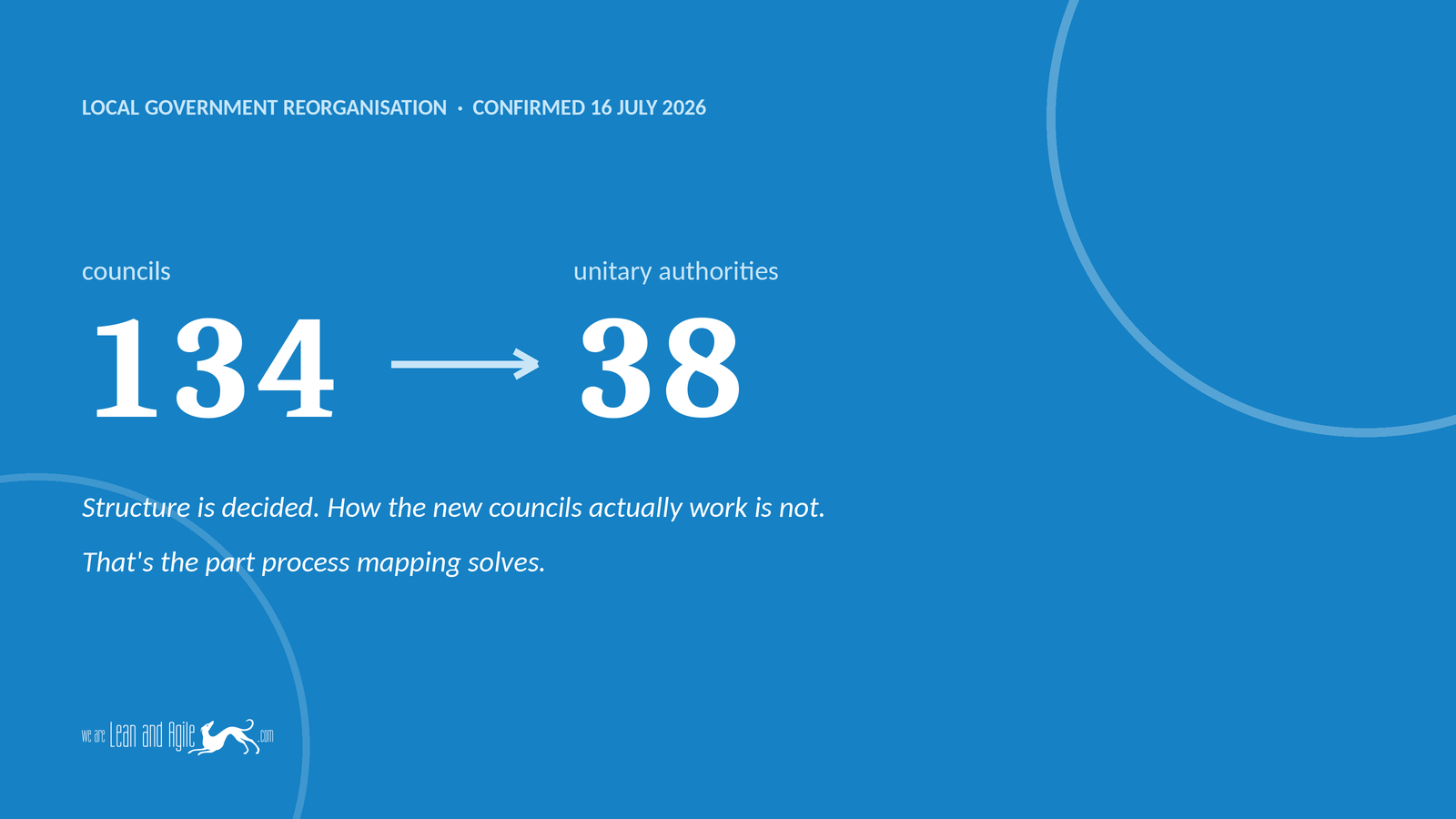
On 16 July, government made it official for another 14 areas: 134 councils — including Kent and Medway, Hertfordshire, and Nottingham and Nottinghamshire — are being reorganised into 38 unitary authorities. For officers in those areas, LGR just stopped being a live consultation with several options on the table. It’s decided. The structure of the new council is set. What isn’t set — yet — is how any of it will actually work.
Let’s be direct about something that rarely gets said in polite company during an LGR programme.
Merging councils does not, by itself, save money.
What saves money is finding all the places where the same work is being done twice, in two different ways, by two sets of people who’ve never spoken to each other. What saves money is eliminating the hand-offs that exist only because they crossed an organisational boundary that no longer exists. What saves money is knowing, clearly, how every service in your new organisation actually works — before you start making decisions about systems, staffing, and digital investment.
None of that happens automatically when you change the name on the letterhead.
Analysis by PwC for the County Councils Network puts the potential savings from LGR at up to £2.9 billion over five years. But — and this is the part that tends to get quietly omitted from the headlines — those savings depend entirely on how the reorganisation is carried out. If the new unitaries are the wrong size, or if the transformation work doesn’t happen at sufficient pace, the savings shrink sharply. In some scenarios, costs increase.
LGR creates the *conditions* for efficiency. Process management is how you actually get there.
What the First Wave of Mergers Actually Taught Us
The councils that formed in the 2019–2023 wave of LGR — North Yorkshire, Somerset, Cumbria and others — went through this before the current cohort. Their experience is instructive, and it’s the clearest evidence available for what the newly confirmed areas are about to face.
**Somerset’s honest lesson: “legal, safe and functioning” isn’t enough**
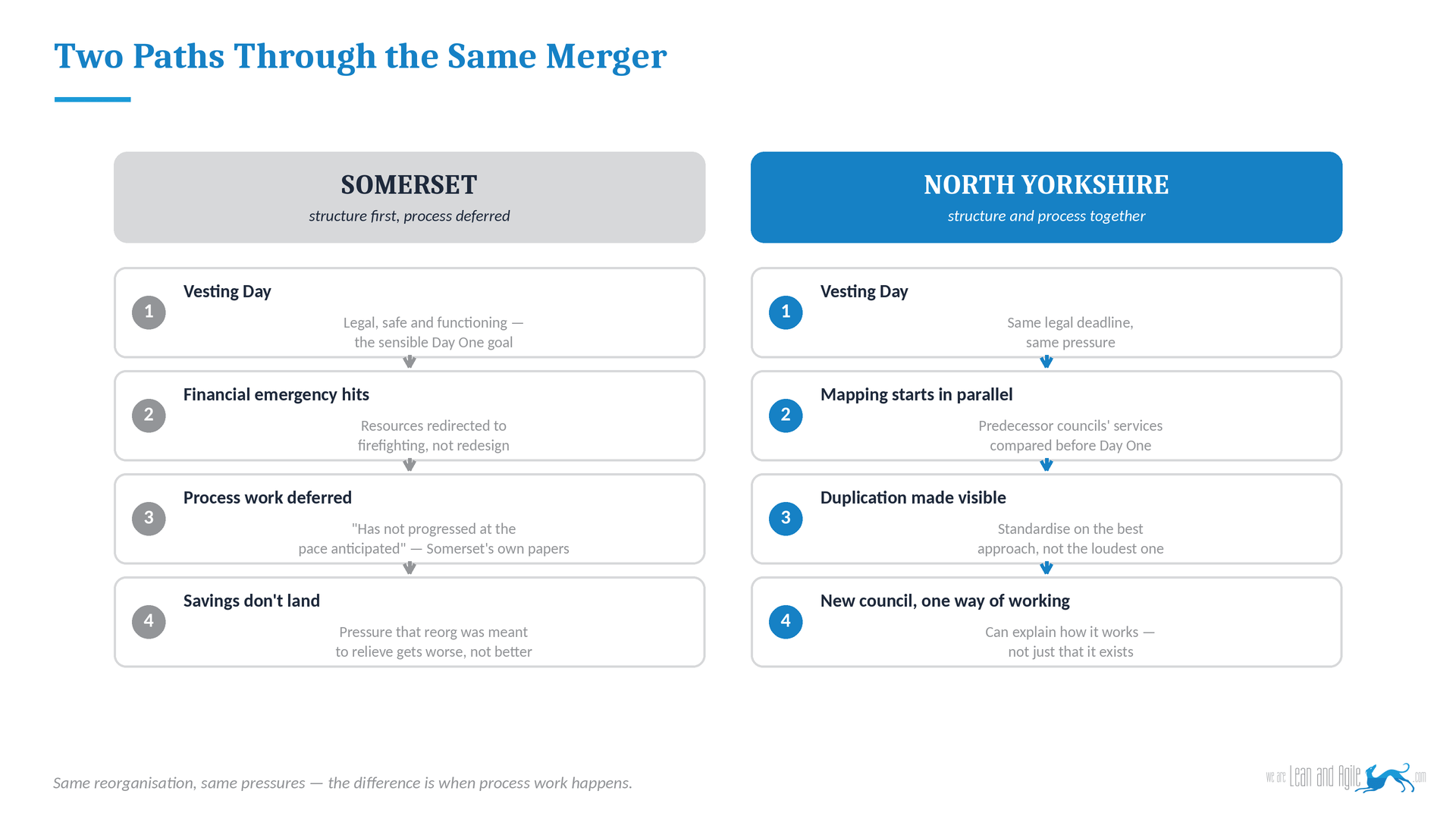
Somerset Council, formed from one county council and four district councils in April 2023, set itself a sensible Day One objective: be legal, safe and functioning. Get the basics right. Don’t try to transform everything at once.
That’s sound advice. The problem is what came next. Somerset’s own governance papers acknowledge that the deeper transformation work — the process redesign, the efficiency improvements, the culture change — “has not progressed at the pace anticipated as resources have been redirected to addressing the financial emergency.”
In other words: the merger happened. The processes didn’t change. The savings didn’t materialise fast enough. And the financial pressure that was supposed to be relieved by reorganisation became more acute, not less.
This is not a criticism of Somerset. It is an almost universal pattern in large-scale reorganisations. The structural work is visible, measurable, and politically driven — it has a hard deadline. The process work is slower, messier, less glamorous, and easy to defer. And it gets deferred, consistently, right up until the point where someone asks why the savings haven’t arrived.
**North Yorkshire: what doing it right looks like**
North Yorkshire Council, formed in April 2023 from eight predecessor organisations, took a different approach. Process management was embedded in the merger programme from the start. Teams used structured process mapping to compare how services were delivered across predecessor councils, identify duplication and standardise the best approaches. The result was a new council that could articulate clearly how it worked — not just that it existed.
The scale was significant: eight councils, covering an area larger than some small countries, with services ranging from waste collection to adult social care. The only way to make decisions about which processes to keep, which to merge, and which to redesign was to make them visible.
**The international warning**
It’s worth looking beyond the UK for a moment. When Queensland, Australia carried out large-scale council mergers, studies of the outcome showed mixed results — some areas achieved meaningful administrative savings, others saw limited financial benefit and considerable community resistance. Northern Ireland’s reorganisation, which reduced 26 district councils to 11, similarly showed that anticipated savings are far from automatic.
The pattern is consistent across different countries and different contexts: reorganisation creates opportunity. Whether that opportunity is realised depends on whether the hard work of redesigning operations actually happens.
The Three Things LGR Programmes Get Wrong
- They treat Day One as the destination
Getting to Vesting Day is treated as the goal. In reality, Vesting Day is just the starting line. The efficiency work — the actual reason the reorganisation was done — begins the morning after. Councils that don’t plan for that systematically find themselves a year post-merger still running seven different ways of processing planning applications, four different approaches to housing repairs, and nobody quite sure which one is cheapest or best.
2. They try to map everything in detail, or nothing at all
Process work in LGR tends to go one of two ways. Either teams launch into detailed mapping of individual services — swimming in swimlane diagrams while 80% of the process estate remains invisible — or the whole thing feels too vast to start, so it doesn’t happen in any structured way.
Neither works. You need a third path.
3. They mistake digital transformation for process improvement
Buying a new CRM, implementing a new ERP, or building a new customer portal are not the same as improving your processes. In fact, digitising a broken or duplicated process just makes it faster and more expensive to do the wrong thing. The process has to come first. Always.
As techUK put it in their LGR guidance: “successful reorganisation cannot be tackled in silos and must be delivered as a joined-up business change programme across people, process and technology.” People. Process. *Then* technology.
The SIPOC-First Approach: A Practical Way to Start
So what does the right process work actually look like in an LGR context, given the time and resource constraints every council is facing?
We recommend starting with what practitioners call a SIPOC map — and doing it for every process in the organisation before committing to detailed mapping of anything.
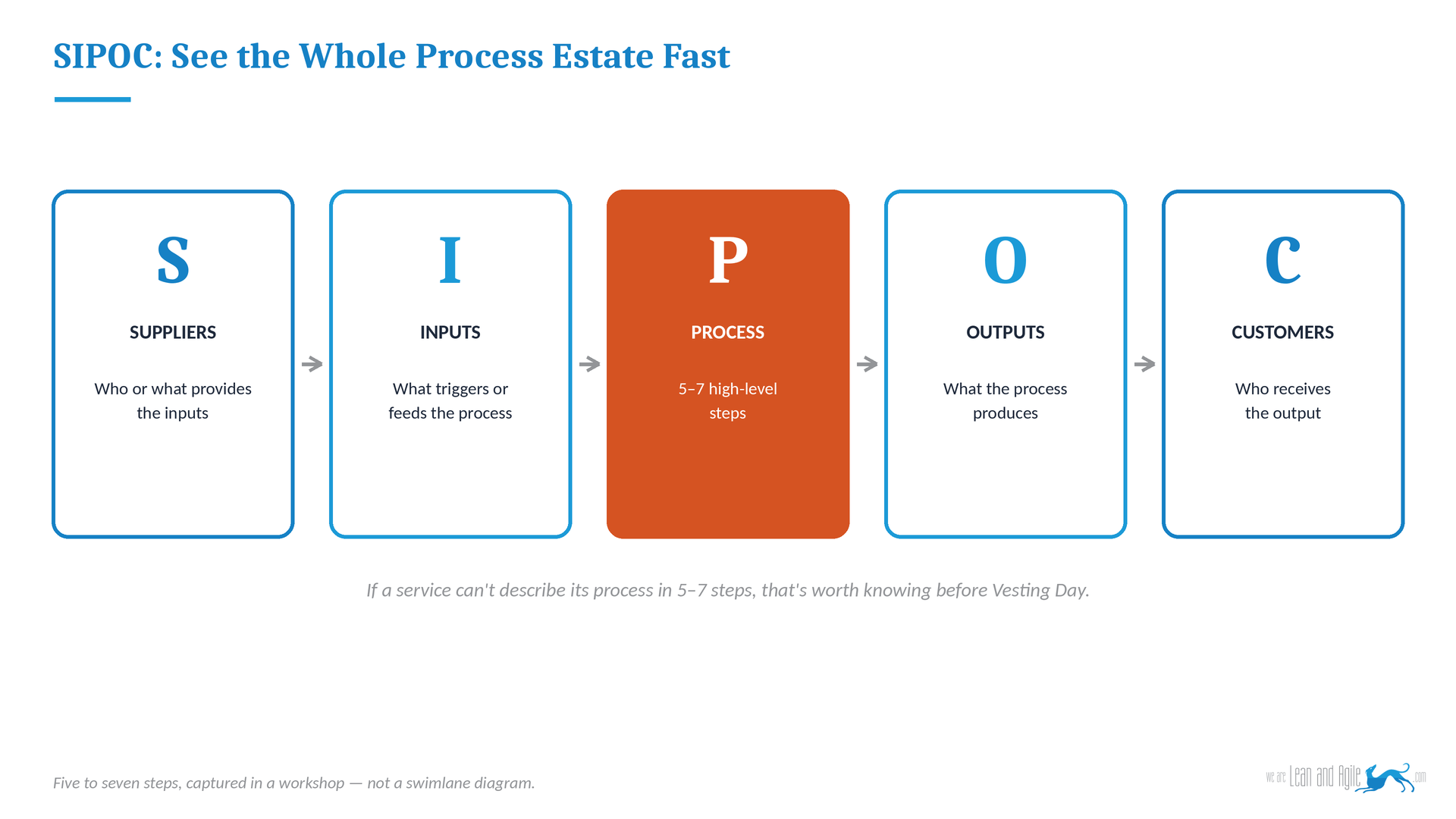
SIPOC stands for:
– **S**uppliers — who or what provides the inputs (other teams, systems, citizens, external partners)
– **I**nputs — what triggers or feeds the process
– **P**rocess — the five to seven high-level steps that describe what happens
– **O**utputs — what the process produces
– **C**ustomers — who receives the output
The five to seven steps discipline is not arbitrary. It forces a level of clarity that is genuinely useful at an organisational level. If a service team cannot describe a process in five to seven steps, that itself tells you something important — either the process is poorly understood, nobody owns it end to end, or it has grown so complicated over time that it needs rethinking before it goes anywhere near a new structure.
A well-facilitated SIPOC workshop can typically capture ten to twenty processes in a half-day session. Run across a service area, you can have a complete process inventory within days. Across an entire predecessor council, within a few weeks.
Why this matters for LGR specifically
When you have the SIPOC inventory for two or three predecessor councils, something immediately becomes visible that was previously hidden: the duplication. Service A in Council One has seven steps. The same service in Council Two has twelve. The outputs are slightly different. The customers are categorised differently. The hand-off points are in different places.
You have now found your harmonisation work. Without writing a single swimlane diagram.
From that inventory, you can triage the process estate into three groups.
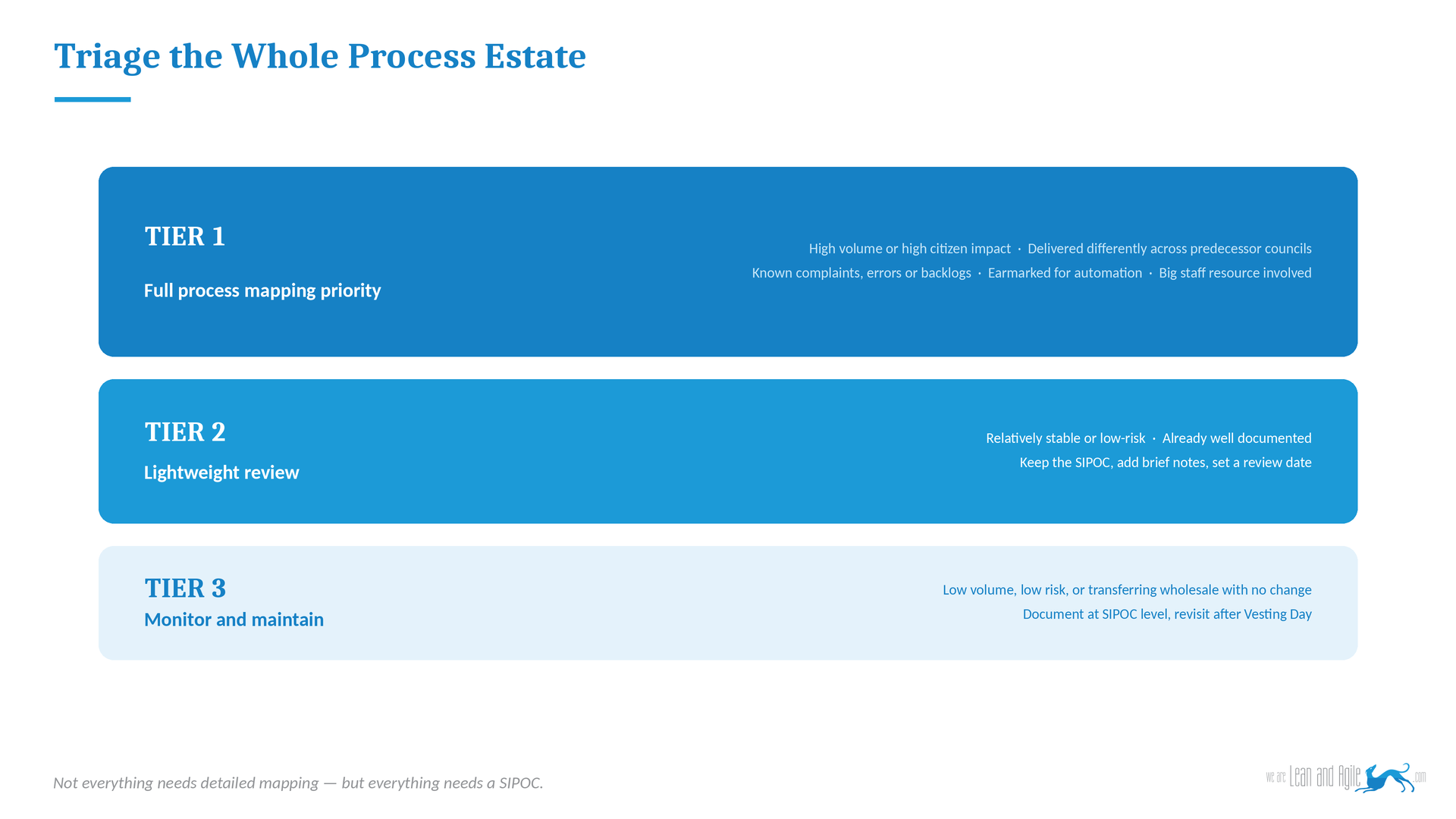
**Tier 1 — Full process mapping priority**
These are the processes that need the full treatment: detailed AS-IS mapping, analysis of time and cost, and a designed TO-BE state. You prioritise them where two or more of the following are true:
– High volume or high citizen impact (planning, revenues and benefits, housing, adult social care)
– The same service is being delivered differently across predecessor councils
– There is a known source of complaints, errors, or backlogs
– The process is earmarked for automation or digital investment
– Significant staff resource is involved — cost savings are available
– Cross-departmental hand-offs that will be affected by the new structure
**Tier 2 — Lightweight review**
Processes that are relatively stable, low-risk, or already well-documented. Keep the SIPOC, add brief notes, set a review date. Don’t invest in detailed mapping until there’s a reason to.
**Tier 3 — Monitor and maintain**
Low volume, low risk, or being transferred wholesale from one predecessor council with no change. Document at SIPOC level and revisit after vesting day.
This structure does something that detailed mapping alone cannot: it gives leadership a *strategic view* of the transformation programme. Not a list of mapping projects, but a prioritised picture of where the real work is, what it will cost to do it, and what savings it is likely to release.
What Good Looks Like
The City of Edinburgh Council mapped over 1,000 processes in two years using this kind of structured, scaled approach. They achieved £175,000 in direct savings with a further £800,000 identified. They did it through a three-step validation process that kept stakeholders involved and created genuine ownership across teams — not something handed down from a transformation team that nobody else felt connected to.
That is the model. Broad visibility first. Triage. Then targeted, high-quality detailed work on the processes where it will actually make a difference.
The Question Worth Asking Right Now
With decisions now confirmed for Gloucestershire, Derbyshire, Warwickshire, Worcestershire, Oxfordshire, Hertfordshire, Leicestershire, Nottinghamshire, East Sussex, Staffordshire, Lancashire, Kent and Medway, Devon, and Lincolnshire — and more areas still to follow — a lot of council teams are about to go through exactly what North Yorkshire and Somerset went through. Some will follow North Yorkshire’s path. Some will follow Somerset’s.
Here is a genuinely useful question to ask your teams this week, wherever your area sits in that list:
*Could you give me a list of every process your service area owns, and describe each one in five to seven steps?*
If the answer is no — and in most councils it will be — then you have your starting point.
The structural work of LGR is largely out of your hands. The process work is not. It is the most direct lever you have on whether the new council delivers on what was promised, or whether the savings that were supposed to arrive by 2028 are still being looked for in 2031.
Structure changes the container. Process changes what happens inside it.
The triage described here is the short version. The register that has to exist before you can triage anything, the field set, who fills in what, and the sequence that follows are all set out in Same Service, Five Different Ways, a free 36-page guide to process harmonisation through reorganisation.
*We Are Lean and Agile are UK resellers and implementers of Engage Process — process mapping and management software used by councils including North Yorkshire, Edinburgh, Somerset and Luton. We offer a 30-day free trial, G-Cloud procurement, and facilitated workshops to help councils build their process inventory quickly. If you’re preparing for LGR and want to talk through where to start, get in touch.*
**About the author**
Andy Sandford is the founder of We Are Lean and Agile, a UK consultancy specialising in process improvement and business transformation for local government. Andy has worked with councils across the UK to implement Engage Process — helping teams map, analyse and redesign their services to deliver better outcomes for citizens and officers alike. With a background spanning digital transformation, continuous improvement, and public sector change management, Andy brings practical experience of what works (and what doesn’t) when organisations try to change how they operate. We Are Lean and Agile are certified Engage Process resellers and implementers, and are available on the G-Cloud framework for straightforward council procurement.